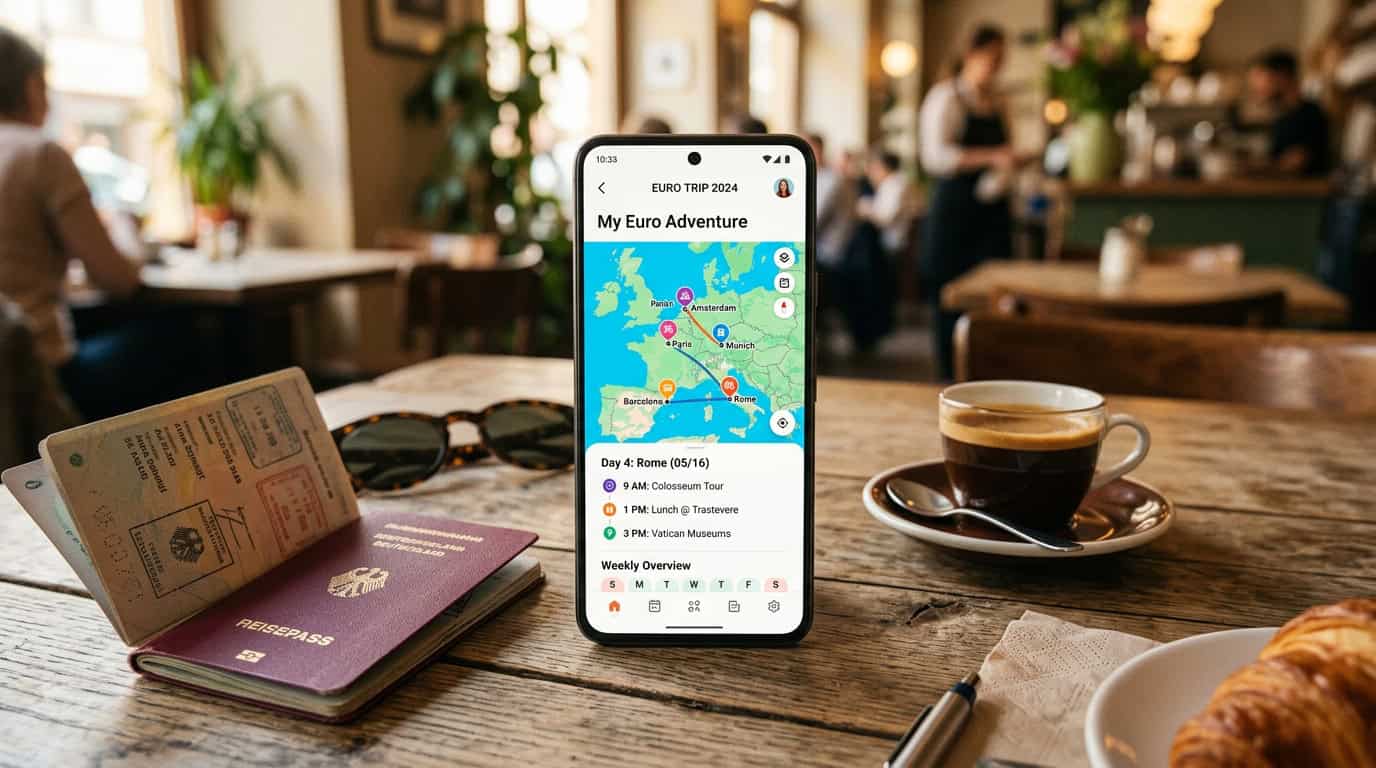
Finding the best AI travel planners became my personal mission after a catastrophic scheduling error in Rome left me stranded outside a closed museum in the pouring rain. I used to pride myself on building massive, color-coded spreadsheets for every overseas trip. I would sit with forty-seven open tabs—cross-referencing Google Maps, airline schedules, hotel reviews, and local transport options—until decision fatigue crushed the excitement right out of me. The sheer volume of choices involved in modern travel planning often turns what should be an exciting process into a logistical nightmare.
We spend hours manually calculating transit times, worrying about overlapping reservations, and trying to figure out if a highly rated restaurant actually fits into our Tuesday afternoon schedule. But the travel landscape demands flexibility, and manual planning simply cannot keep up with real-time variables. By analyzing millions of data points, modern travel applications have pivoted from simple search engines to contextual reasoning engines. If you are already planning multi-stop trips, this guide pairs especially well with route-heavy reads like getting around Bangkok and the highly practical Italian road trip guide.
Quick Summary
The Direct Answer: Do AI Trip Planners Actually Work?
Yes, but you must align your expectations with reality. If you expect a single application to flawlessly read your mind, book the cheapest flights, locate local street food vendors, and secure an immaculate hotel in one click, you will be disappointed. However, if you treat AI travel planners as highly organized, collaborative travel agents, they are profoundly effective.
Tools like TriPandoo and Layla.ai are exceptionally powerful for eliminating the initial heavy lifting of vacation mapping. They generate structured, sensible itineraries in seconds based on your specific budget and pacing constraints. The true value lies in conversational editing—using the AI to build a foundational blueprint, and then tweaking it manually. You still remain the ultimate editor of your journey, but the software saves you dozens of hours of logistical math.

The Problem With Traditional Travel Planning
Manual vacation planning is an exercise in managing anxiety. You find a great hotel in Paris, but then you have to figure out how far it is from the Louvre. You map the walking route, calculate the transit time, and try to squeeze in a lunch reservation in Le Marais. By the time you string together three days of activities, your brain is fried.
I once booked a cheaper ferry in Greece thinking I would save exactly EUR15. I failed to cross-reference the wind patterns and transit delays for that specific route. It turns out the four-hour ride in choppy waters cost me half a day of exploration because I was far too nauseous to move once we docked. Traditional planning leaves massive gaps for human error because we simply cannot process every single variable at once.
Static itineraries also breed rigidity. When you print out a PDF of your schedule, you feel obligated to stick to it. If it rains in Barcelona on the day you planned to visit the beach, a static spreadsheet offers no alternative solutions. You are left scrambling on your phone in a hotel lobby, trying to find indoor activities with immediate ticket availability. That problem becomes even worse on complex routes like a Fukuoka travel itinerary or a layered Ho Chi Minh City travel guide schedule where timing matters.
General Large Language Models vs. Specialized Travel AI
To understand what makes the best AI travel planners so effective in 2026, we have to look at how they handle complex constraints compared to standard AI. Recently, travel data analysts ran a rigorous test using a highly constrained prompt to test five different AI platforms: ChatGPT, Perplexity, Mindtrip, Layla, and iMean AI.
The test scenario was brutal: “We are four friends planning a two-week trip in September. We want to visit Japan and South Korea. One traveler hates long layovers, one prefers boutique hotels, and one has a tight budget. We want good food experiences, minimal backtracking, and at least one nature destination. Flights should avoid overnight connections.”
ChatGPT and Perplexity failed this test miserably. ChatGPT acted like a brainstorming partner, offering broad ideas but failing to structure a cohesive itinerary or pull real-time flight data. It gave generic hotel suggestions without checking current prices. Perplexity operated like an academic search engine—great for historical facts about Kyoto, but useless for booking a flight without an overnight layover.
Specialized tools integrated with live data networks passed the test. They successfully synthesized the nine conflicting constraints, delivering a logical itinerary that balanced cultural experiences with strict budget requirements. They recognized that the routing required a specific open-jaw flight path to avoid backtracking between Japan and South Korea. That same kind of reasoning also matters for practical transit shifts like the ones covered in Japan transit payment changes.
The Best AI Travel Planners & Apps Ranked for 2026
No single app provides a flawless end-to-end experience. Instead, the smartest travelers in 2026 are using a “stack” of specialized tools. Here are the top performers based on extensive testing, categorized by their specific strengths.
1. Layla.ai: The Best Conversational Co-Pilot
Layla.ai represents the future of interactive travel planning. Instead of dragging and dropping items on a digital calendar, you speak to the system naturally. If you look at your generated schedule and realize Tuesday looks too exhausting, you can type, “Shorten my train transfer in Florence and add more downtime before dinner.”
Layla integrates directly with major booking networks to pull live pricing and availability. It recalculates your transit times instantly, estimating new associated costs without breaking the rest of your schedule.
Pros: Incredible conversational interface; dynamic recalculation; prevents scheduling domino-effects.
Cons: Highly restrictive freemium model; new users often hit a paywall after just three robust prompts.
2. TriPandoo: The Fastest Itinerary Generator
Positioned as a heavy-hitting AI generator, TriPandoo automates the heavily manual process of routing. It claims to generate custom itineraries in under 30 seconds. It excels at spatial reasoning—knowing exactly when it is more efficient to fly, drive, or take a high-speed train between multi-city stops.
Pros: Lightning-fast generation; smart routing to optimize time; offers a very clean user interface.
Cons: The free tier is highly restrictive, limiting users to generating only 5 days of travel per month before requiring a $9.99/month Pro upgrade.
3. Wanderlog: The Group Collaboration Winner
Wanderlog is visually stunning and acts as the ultimate digital canvas for group travel. While its AI drafting tools are solid, its true power lies in real-time, multi-player syncing. Friends can seamlessly add, edit, and view journey plans together. It also features built-in cost-splitting tools, eliminating the need for a separate app like SplitWise.
Pros: Top-tier collaborative tools; beautiful map integrations; excellent for coordinating large groups or families.
Cons: Crucial features like offline map access and automated email importing are locked behind a steep $63.99 annual Pro subscription.
4. TripIt: The Logistics and Organization Veteran
TripIt remains the reigning champion of post-booking organization. It does not use generative AI to invent a trip from scratch; instead, it acts as a master aggregator. By linking your email, TripIt automatically sniffs out booking confirmations for flights, hotels, and rental cars, compiling them into a flawless master timeline.
Pros: Unmatched for business travelers; highly reliable offline access even on the free tier; exceptional automated parsing.
Cons: Lacks generative AI features; the interface feels slightly dated compared to modern startup apps. TripIt Pro costs roughly $49 to $68 annually depending on regional platform fees.
5. Roadtrippers: The Overland Adventure Standard
Driving vacations require an entirely different set of logistical rules. If you plan to drive the Pacific Coast Highway, you cannot simply look at total mileage and divide it by speed limits. Roadtrippers optimizes scenic routes while strictly managing overnight stops to prevent driver fatigue. It calculates highly accurate fuel costs and highlights quirky roadside attractions along your exact path.
Pros: Unrivaled for vehicular travel; highly accurate gas estimations; RV-specific routing options.
Cons: Useless for international flights or urban backpacking. The free tier is heavily restricted (limiting you to a maximum of 3 stops), forcing serious drivers to buy the $59.99/year Premium version.

Essential Supplementary Tech for 2026
While AI planners build the schedule, executing the trip requires a few additional specialized applications.
Hopper for Predictive Flight Pricing:
If you have rigid travel dates but are unsure of the optimal time to purchase tickets, Hopper is essential. It tracks historical flight data and predicts exactly when a flight price will rise or drop, sending you an alert the moment you should buy.
Maps.me for Offline Navigation:
I learned this lesson the hard way during a solo trip in Ecuador. I lost cellular service on a poorly signposted mountain loop and Google Maps failed me completely. Maps.me allows you to download massive, highly detailed regional maps over Wi-Fi before you leave, ensuring your GPS continues to route you accurately without a single bar of cell service.
What3words for Exact Locations:
This revolutionary location app divides the entire globe into exact 3-meter squares, assigning a unique three-word code to each. If you are meeting a tour guide at a massive, chaotic location like the Tower of London or Mount Kilimanjaro, entering a code like swift.blitz.funds pinpoints your exact physical location, eliminating language barriers and vague directions.
Cost Breakdown: Free vs. Paid Travel Apps
Understanding the financial landscape of travel tech is critical before committing your data to a platform. Here is a realistic look at the premium tiers for top travel apps.
Common Mistakes to Avoid When Using Travel Tech
While AI dramatically improves the planning process, human users still make frequent errors when interacting with these softwares. Based on extensive trial and error, you must watch out for these traps.
Mistake 1: Trusting AI Transit Times Without a Buffer
Algorithms calculate transit based on perfect, frictionless conditions. If the AI says the bus ride from the airport to the city center takes exactly 45 minutes, it assumes the bus arrives immediately upon your exit from the terminal. It does not account for the twenty minutes you spend waiting for your luggage, or the ten minutes you spend trying to find the correct ticket kiosk. Always manually inject a 30-minute buffer into any AI-generated transit sequence.
Mistake 2: Overpacking the Schedule Due to FOMO
Because artificial intelligence can generate a minute-by-minute schedule instantly, users often ask it to cram as much into a single day as mathematically possible. Just because you can sequence five major historical sites into a nine-hour window does not mean you should. Physical exhaustion is real. I made this mistake in Rome, scheduling the Vatican and the Colosseum on the same day. By 3:00 PM, my feet were blistered and I retained absolutely nothing about the architecture. Tell your AI planner to restrict you to one major anchor activity per day.
Mistake 3: Blindly Trusting Business Hours (AI Hallucinations)
AI tools, particularly newer ones like Wanderboat or ChatGPT, frequently suffer from “hallucinations” regarding local business hours. They might confidently schedule you for a highly rated local cafe on a Monday, failing to realize that nearly all non-tourist restaurants in that specific European city close on Mondays. Always cross-reference the AI’s suggestions directly against Google Maps or the official business website before locking in your day.

Who Should Use AI Travel Planners (And Who Should Not)
This technology is transformative, but it is not the perfect solution for every single type of traveler.
- The Overwhelmed Organizer: If you are the designated planner for a group of friends or a family, the collaborative editing features of apps like Wanderlog will save your sanity. Everyone can view the live itinerary and stop asking you what time the flight leaves.
- The Multi-City Backpacker: Anyone attempting to navigate trains, flights, and buses across four different countries in two weeks desperately needs the spatial routing optimization of an AI planner to prevent geographical backtracking.
- The Budget-Conscious Traveler: If you need to manipulate dates and destinations rapidly to find the absolute cheapest combination of flights and hotels, the live-pricing integration of these tools is unbeatable.
- The Completely Spontaneous Traveler: If you prefer arriving in Tokyo with zero booked accommodations and just walking until you find a hostel you like, generating a structured AI itinerary defeats the entire purpose of your travel style.
- The Hyper-Local Explorer: AI models rely on indexed internet data. The system will not know about the pop-up street food stall that only operates on alternating Tuesdays, or the underground art gallery that has no website. If you travel strictly by local word-of-mouth, AI recommendations will feel slightly too mainstream.
Frequently Asked Questions
How far in advance should I use an AI planner to book my trip?
To secure the most affordable flights and preferred hotel rooms, you should finalize your AI itinerary and book your major tickets 6 to 9 months in advance. If you are traveling during major holidays or peak summer weeks, extend that timeline to a full year in advance to guarantee availability, as AI cannot bypass sold-out inventory.
Does Trip Planner AI actually book the flights and hotels for me?
No, most AI travel planners do not hold your credit card funds directly. Instead, they act as centralized search engines. They pull live pricing from trusted third-party partners like Skyscanner for flights or Booking.com for accommodations. When you are ready to purchase, they securely route you to those native platforms to complete the transaction.
When is the cheapest time to travel to Europe according to the data?
Data consistently points to the shoulder months of September and October as the optimal time for budget travel to Europe. During this window, summer tourist crowds have dispersed, dramatically lowering hotel demands, yet the weather remains generally warm and pleasant enough for outdoor exploration.
Will AI apps warn me about the new 2025/2026 visa requirements?
High-end planners integrate regulatory alerts into their dashboards. For example, if you are a U.S. citizen building an itinerary for Europe, the best tools will flag the mandatory ETIAS requirement taking full effect. They will also remind you to verify that your passport has at least six months of remaining validity.
Final Verdict and Next Steps
Using the best AI travel planners represents a massive leap forward from the days of messy spreadsheets and overwhelming browser tabs. By offering dynamic recalculation, intelligent route optimization, and personalized pacing for families and groups, this technology removes the logistical anxiety from vacation preparation.
While AI currently lacks the hyper-local nuance of a resident’s deeply guarded secrets—and occasionally struggles with accurate business hours—its ability to sequence a flawless multi-city European tour or map out a stress-free Pacific Coast Highway drive is unmatched.
If you are planning a trip for 2026, my strongest recommendation is to start with an AI ideation tool like Layla.ai to build your foundation. Run your basic parameters, budget, and constraints through the machine first. Let the software handle the spatial math and transit routing. Once the blueprint is generated, import it into an organizer like Wanderlog or TripIt, verify the details manually, and focus your energy on actually enjoying the anticipation of your journey. For inspiration after the planning phase, you can also browse bucket list travel destinations.