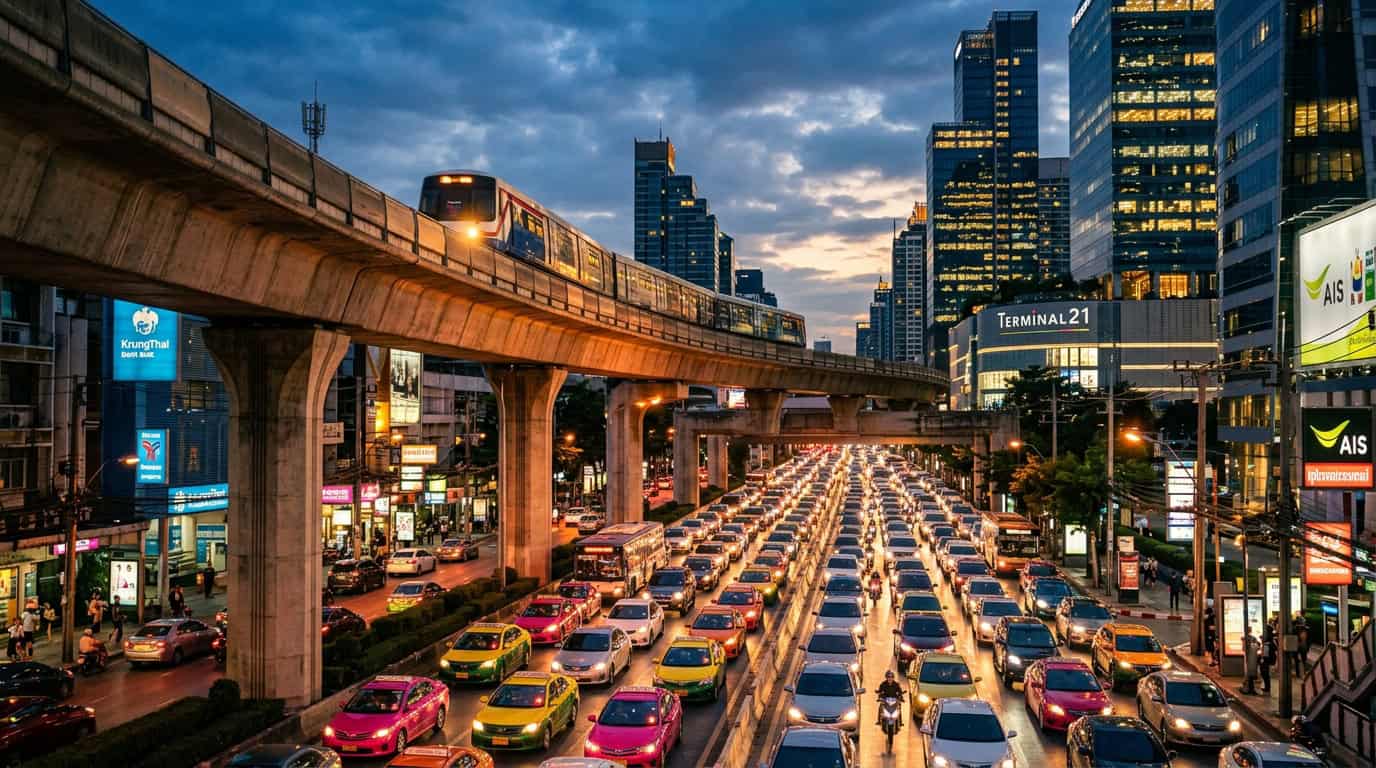
If you want to preserve your sanity and avoid spending half your vacation staring at the brake lights of a delivery truck, mastering getting around Bangkok is the single most important skill you can learn. The Thai capital is a sprawling, sweltering metropolis home to over 15 million daily commuters. Traffic rules are treated as loose suggestions, the sidewalks are notoriously unreliable, and the midday humidity can turn a ten-minute walk into an intense, sweat-drenched workout.
But here is the good news: beneath the surface-level chaos lies an incredibly diverse, affordable, and expanding transportation ecosystem. You don’t have to suffer in gridlock. By strategically combining elevated trains, underground subways, river ferries, canal boats, and ride-hailing apps, you can bypass the worst of the congestion entirely. If you are also planning a wider Thailand trip after Bangkok, these guides to hidden destinations in Thailand and offbeat Thailand destinations are useful next reads.
Quick Summary
The Direct Answer: What is the Best Way to Navigate the City?
The absolute best strategy for navigating this massive city is adopting a “mixed-mode” approach. Do not commit to just one form of transport, and do not try to replicate how you move in a Western city.
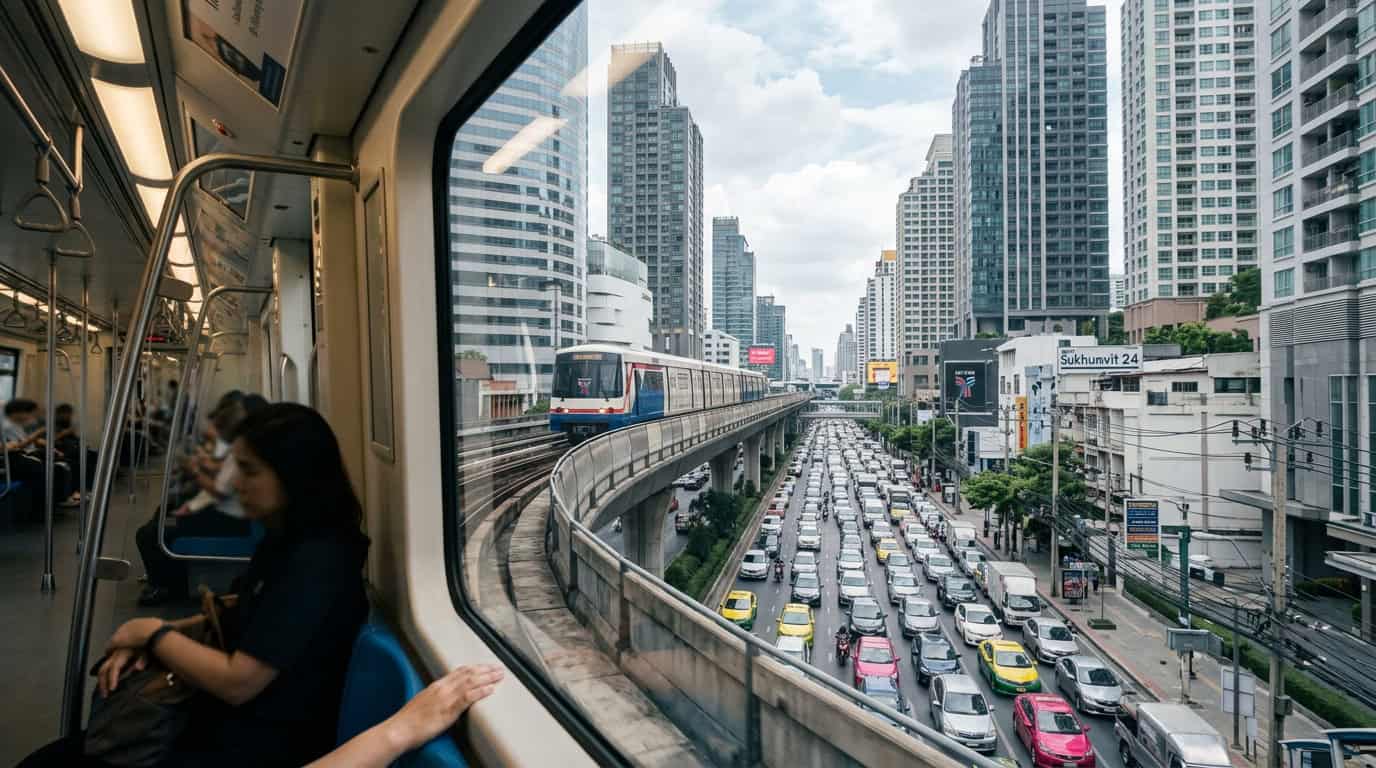
For the vast majority of your travel, use the elevated BTS Skytrain or the underground MRT Subway. They operate from roughly 5:30 AM to midnight and completely bypass the unpredictable surface gridlock. Use these rail networks to jump between major clusters like Sukhumvit, Silom, and Chinatown.
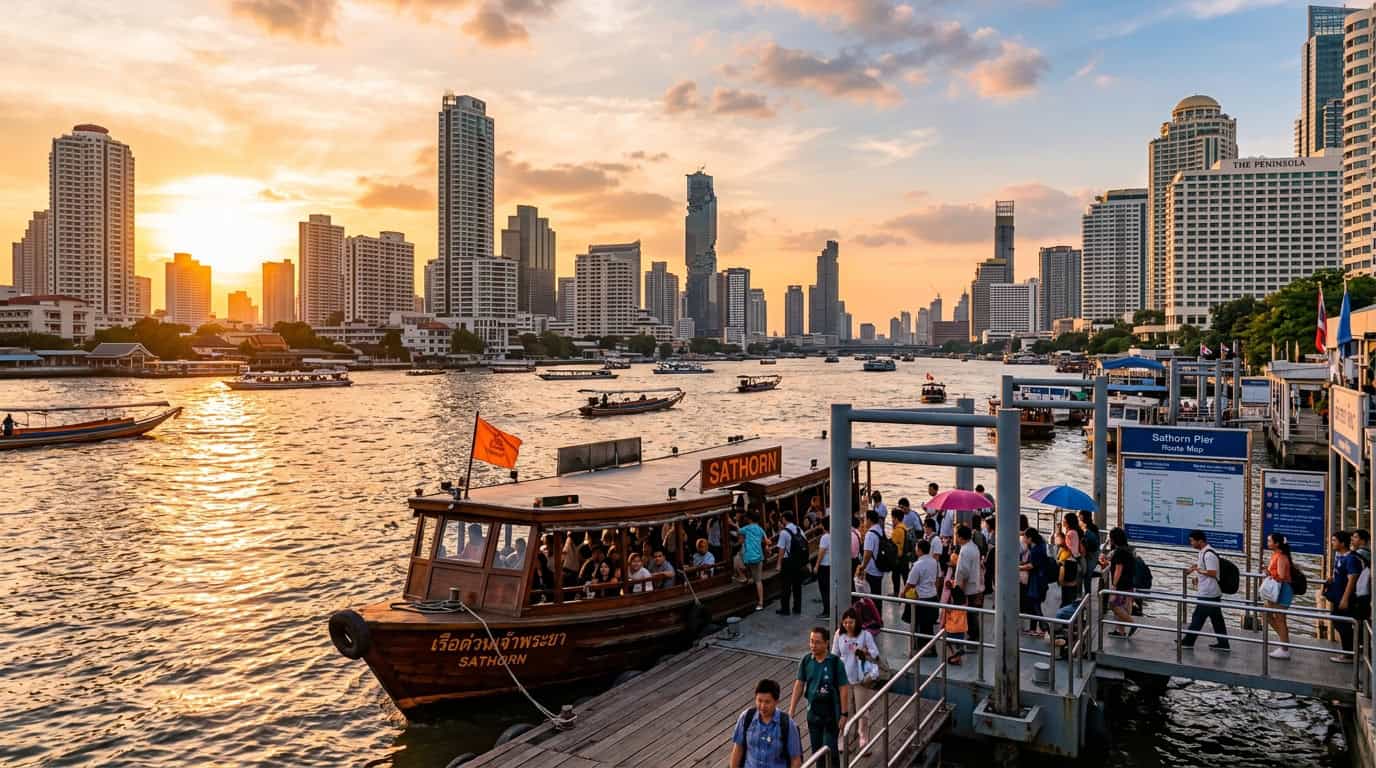
However, trains don’t go everywhere. When visiting the historic Old City, where the Grand Palace is located, you must transition to the river. Take the BTS to Saphan Taksin station, walk to Sathorn Pier, and catch a Chao Phraya Express Boat. Finally, reserve road transport like metered taxis, the Grab app, or an orange-vested motorbike taxi strictly for short last-mile trips from a train station to your specific hotel or restaurant. By matching the transport mode to the neighborhood and time of day, you minimize heat exposure and maximize your actual exploring time.
Arriving in the Capital: The “First-Hour” Airport Strategy
Your first logistical challenge sets the tone for your entire trip. The city operates two distinct airports, and your arrival point dictates your transit options. I highly advise against improvising your transport after a long flight—make a concrete plan before you land.
Suvarnabhumi Airport (BKK) – The International Hub
Located 25 kilometers east of downtown, BKK offers the most straightforward mass transit connection. The Airport Rail Link (ARL) is hands down the most efficient way to bypass highway traffic.
The ARL operates from 5:30 AM to midnight, with trains departing every 9 to 15 minutes. It takes roughly 22 minutes to reach Makkasan station for 35 THB, or 26 minutes to reach Phaya Thai for 45 THB.
If you must take a taxi, follow the signs to the official public taxi stands on Level 1. Expect to pay between 250 and 400 THB to reach downtown, plus the unavoidable 50-baht airport surcharge and any highway tolls, usually around 75 THB.
Don Mueang Airport (DMK) – The Regional Hub
Located 21 kilometers north, DMK primarily services domestic and budget airlines like AirAsia.
For rail access, the SRT Red Line connects the airport to the new Krung Thep Aphiwat central railway station. However, this requires a solid 5 to 10 minute walk from the terminal to the station. If you have a family or heavy bags, this is exhausting.
Alternatively, the A1 and A2 Airport Shuttle Buses are incredibly efficient. These orange buses drop you right at the Mo Chit BTS station stairs. They run every 20 minutes, cost exactly 30 THB, and you pay the conductor in cash once you take a seat.
The Heavy Lifters: BTS Skytrain and MRT Subway
If you are getting around Bangkok efficiently, you will spend a lot of time on these two networks. They are heavily air-conditioned, highly punctual, and surprisingly cheap.
The BTS Skytrain (Elevated Transit)
The original elevated commuter rail system features two primary routes: the Sukhumvit Line and the Silom Line, intersecting at the massive Siam Station interchange.
Fares range from 17 to 65 THB based on distance. If you plan to use the train frequently, do not buy single-journey tickets every time. The ticket machines generate brutally long lines, especially at stations like Asok and Siam.
Instead, purchase a Rabbit Card. It costs 50 THB as a non-refundable issuance fee, plus whatever travel credit you load onto it. You simply tap and go at the turnstiles.
If you plan to ride heavily in a single day, the 1-Day Pass for 150 THB is excellent. Just note that it expires at midnight on the day of purchase, not 24 hours from the first swipe.
The MRT Subway (Underground Transit)
The MRT is crucial for reaching areas the BTS misses. The circular Blue Line is particularly vital for tourists, connecting the modern downtown directly to Chinatown at Wat Mangkon station and the Grand Palace area at Sanam Chai station.
Fares range from 17 to 45 THB per trip. The MRT recently upgraded its turnstiles, allowing you to tap your physical Visa or Mastercard directly on the gate reader. This is a massive time-saver and means you don’t even need to buy an MRT card or token.
The Annoying Reality of Separate Systems
Bypassing the Gridlock: River Ferries and Canal Boats
Navigating the waterways is highly scenic, incredibly cheap, and ignores road traffic entirely. It was historically the primary way locals moved, and it remains a massive cheat code for modern travelers.
Chao Phraya Express Boats
The Chao Phraya River serves as the western boundary of the modern city and the main artery for historical tourism. The boat system uses colored flags on the roofs to dictate routes and stops.
Commuter Boats (Orange Flag): These are the workhorses of the river. They run all day, stop at key piers, and cost a flat 15 to 20 THB. You pay a conductor who shakes a metal coin cylinder. Stick to these for budget travel.
Tourist Boats (Blue Flag): These cost 60 THB for a single ride or 200 THB for an all-day pass. They stop at major tourist piers like Wat Arun and ICONSIAM, feature English-speaking guides, and have a more relaxed boarding process.
Cross-River Ferries: Little motorized rafts that simply go from one side of the river to the other, essential for crossing from Wat Pho to Wat Arun. They cost roughly 5 THB.
Saen Saep Canal Boats (Khlongs)
Running east-to-west through the center of the city, these loud, low-slung wooden boats navigate the narrow inner canals. Fares range from 10 to 20 THB.
The Road Warriors: Ride-Hailing, Taxis, and Tuk-Tuks
When the trains and boats don’t reach your destination, you must brave the surface roads.
Ride-Hailing Apps (Grab, Bolt, MuvMi)
The smartest way to travel by car is using smartphone apps. Grab is the regional equivalent of Uber. While it is generally 20% more expensive than a flagged street taxi, it provides absolute price transparency, links to your credit card, and completely removes the language barrier.
Bolt is a highly popular alternative that frequently offers cheaper rates than Grab, though wait times can be slightly longer during peak hours. For short, eco-friendly trips around downtown, the MuvMi app allows you to hail electric, shared tuk-tuks at a fixed, low price without any haggling.
Metered Taxis
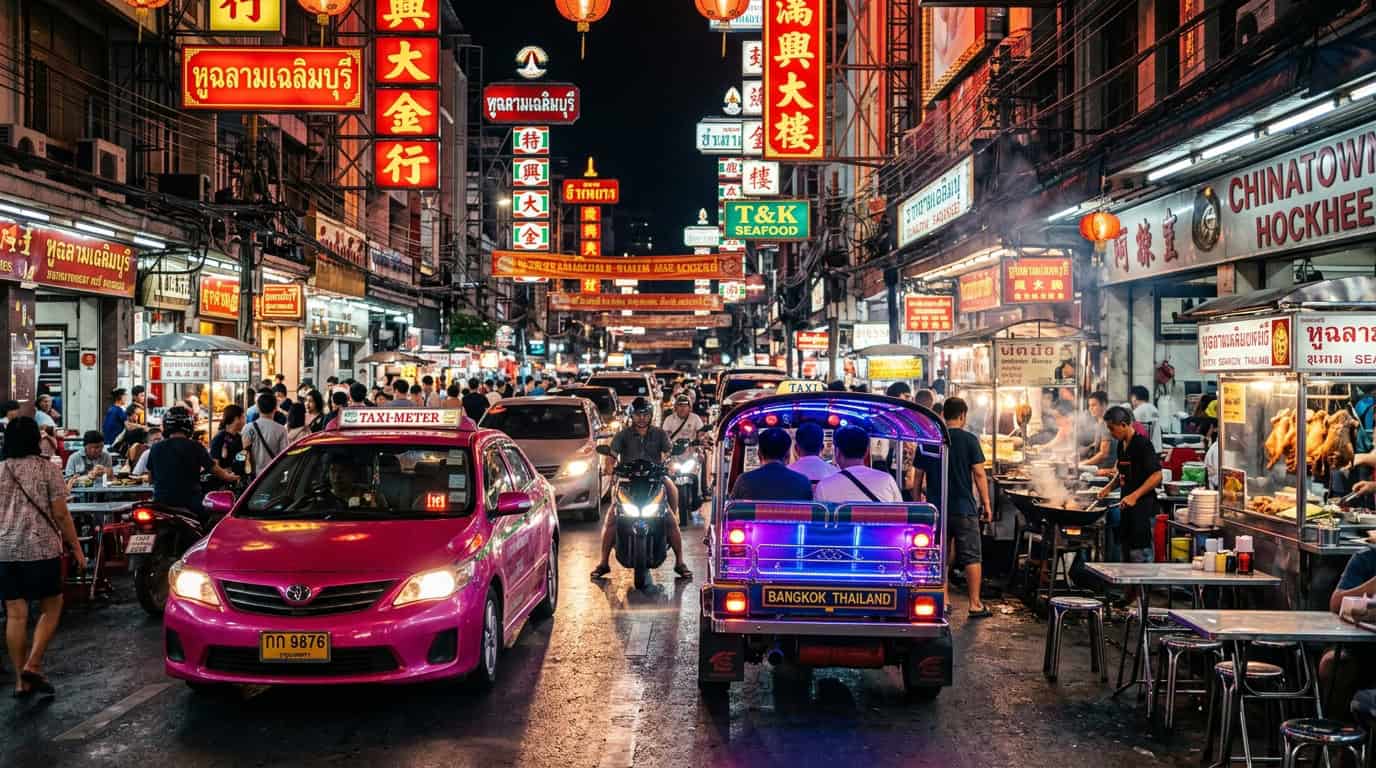
The city has over 80,000 brightly colored taxis. The base fare is incredibly cheap: just 35 THB. Short trips across downtown usually cost under 150 THB.
The golden rule of using taxis is to ensure the driver turns on the meter. If a parked driver quotes a flat rate like “300 baht to Sukhumvit”, simply say no, walk away, and hail a moving taxi instead. Taxis parked outside major tourist landmarks or nightlife districts are notorious for refusing the meter.
Tuk-Tuks and Motorcycle Taxis
Tuk-Tuks are open-air, three-wheeled motorized rickshaws. They are a cultural icon and a fun novelty, but they are not practical daily transport. They have no meters, meaning drivers will usually open negotiations at a steep 150 to 200 THB for even a five-minute ride. Use them once for the photos, negotiate the price before you get in, and hold onto your bags.
Motorcycle Taxis (Motorsai) are recognizable by drivers wearing bright orange vests at the corners of busy intersections. They are the ultimate last-mile solution for zipping down long, narrow side streets. Fares are usually 20 to 60 THB. Always ask the driver for a helmet, and tuck your knees in tightly to avoid clipping passing car mirrors.
The Budget Option: Public Buses
If you have more time than money, the city bus network is extensive and incredibly cheap. Fares range from 8 THB for older, non-air-conditioned red buses, up to 25 THB for modern, blue air-conditioned vehicles.
Recently, the city has introduced a fleet of sleek, quiet EV buses, often called Thai Smile Bus. If you plan to ride these frequently, you can purchase a HOP Card for tap-and-pay convenience.
The biggest challenge with buses is navigation, as routes are complex and traffic delays are severe. Download the ViaBus app, which provides real-time GPS tracking of approaching buses and takes the guesswork out of the system.
Cost Breakdown and Value Scenarios
Understanding the financial trade-offs helps you plan effectively. Here is a realistic look at what transportation costs based on your travel style.
The “Last-Mile” Problem and the Walking Trap
Looking at Google Maps, you might see that your destination is only a 15-minute walk from the BTS station. In a Western city, you would walk it. Here, that is often a mistake.
The combination of 90% humidity, intense UV rays, and 35°C heat creates a brutal heat stack effect. Furthermore, the sidewalks are frequently blocked by food carts, utility poles, or uneven paving stones, forcing you into the street.
Common Mistakes to Avoid
Mistake 1: Falling for the “Closed Temple” Scam
This is the oldest trick in the local playbook. As you walk toward a major site like the Grand Palace, a friendly tuk-tuk driver or well-dressed local teacher may intercept you and claim the temple is closed for a holiday or cleaning. They then offer a cheap sightseeing detour that usually ends at a tailor or gem shop where they earn commission. Do not believe them. Politely smile, say no, and keep walking to the main gate.
Mistake 2: Taking Taxis During the Evening Rush Hour
Between 5:00 PM and 7:30 PM, major roads like Sukhumvit, Sathorn, and Silom turn into literal parking lots. If you hail a taxi or book a Grab during this window, you will pay the meter’s idling charge simply to sit stationary. Always switch to the BTS or MRT during these hours.
Mistake 3: Creating App Conflicts at Local Taxi Stands
If you use Grab or Bolt to call a motorcycle taxi, do not stand directly in front of a local orange-vest motorcycle taxi stand while waiting for your app driver. This creates tension and is considered highly disrespectful to the local drivers who pay to operate at that corner. Walk a hundred meters down the street before calling your app ride.
Who Should Use Which Transit Mode (And Who Should Not)
Choosing your transport depends heavily on your physical abilities, group size, and location.
- Solo travelers and couples who want to maximize sightseeing time.
- Travelers staying in modern commercial districts like Sukhumvit, Siam, and Silom.
- Anyone moving during the morning or evening rush hours.
- You are traveling with a family of four and splitting a 150-THB Grab is easier than buying multiple train tickets.
- You have mobility issues or use a wheelchair. The MRT is better equipped with elevators, while the BTS has inconsistent elevator access.
- You are traveling to or from the airport with large, heavy luggage.
- You are wearing expensive or light-colored clothing, as canal water frequently splashes over the sides.
- You have poor balance. Boarding requires stepping from a bobbing pier onto a narrow moving boat that only pauses for a few seconds.
Frequently Asked Questions
Is the Grab app legal and safe to use in Bangkok?
Yes, Grab is legal, regulated, and widely used. It offers extra safety for tourists because every driver is registered, trips are GPS-tracked, and payment is handled digitally through the app. It also removes the risk of meter scams or destination miscommunication.
Do the trains run 24 hours a day?
No. Both the BTS Skytrain and MRT Subway shut down shortly after midnight. The last trains usually leave terminal stations around 11:45 PM, and service resumes around 5:30 AM to 6:00 AM.
Am I supposed to tip taxi and tuk-tuk drivers?
Tipping is not strictly required in Thailand, but it is appreciated. For metered taxis, many travelers simply round up to the nearest 10 or 20 baht. For tuk-tuks, because the fare is agreed in advance, no additional tip is normally expected.
Can I rent a scooter or car to get around myself?
Unless you are very experienced with Southeast Asian traffic, this is heavily discouraged. Bangkok traffic is aggressive, confusing, and exhausting. For most visitors, public transit and professional drivers are far safer choices.
Final Thoughts on Conquering the Commute
Getting around Bangkok doesn’t have to be intimidating. By shifting your mindset from door-to-door car rides to a strategic, multi-modal approach, you unlock the true speed of the city.
The BTS and MRT are your heavy lifters for crossing the urban sprawl quickly. The river boats are your keys to unlocking the historic districts with a cooling breeze. Ride-hailing apps and motorbike taxis fill in the gaps when the rails run out.
Download Grab and ViaBus, buy a Rabbit Card on your first day, always carry a pocket full of small 20-baht notes for the boats, and you will navigate this incredible city with the confidence of a seasoned local. After Bangkok, you can also continue your Thailand planning with Best Hidden Destinations in Thailand and Offbeat Thailand Destinations Guide.