Any honest Nusa Penida travel guide needs to begin with a stark warning: this rugged island will test your physical endurance just as much as it rewards your camera roll. Located roughly 45 minutes by fast boat southeast of mainland Bali, across the choppy Badung Strait, Nusa Penida is the largest of a three-island archipelago that includes Nusa Lembongan and Nusa Ceningan. It smells of diesel fumes at the harbor, clove cigarettes at the roadside warungs, and thick, salty sea air along the cliffs. It is a place of sheer, dramatic coastal drops, intense tropical heat, and some of the most spectacular marine biodiversity on the planet.
If you usually like remote island escapes, you may also enjoy comparing this trip with Gili Meno Travel Guide or broader inspiration from Best Bucket List Travel Destinations for 2026.
Quick Summary
The Direct Answer: How Many Days Do You Actually Need?
If you are wondering whether you can squeeze Nusa Penida into a single day trip from Bali, the short answer is yes—but you absolutely shouldn’t. A day trip guarantees you will spend the majority of your time sitting on a humid ferry, waiting in suffocating traffic on single-lane dirt roads, and fighting massive crowds for a quick photograph before rushing back to the harbor.
To properly experience this island, you need a minimum of two to three full days. Dedicate your first day entirely to the heavily trafficked Western circuit, starting as early as 6:30 AM to beat the day-trippers. Dedicate your second day to the remote, quieter Eastern side. If you have a third day, use it exclusively for marine activities like scuba diving or snorkeling at Manta Point, or tracking down deep-cut locations like the Tembeling Forest. Slowing down not only preserves your sanity but allows you to actually absorb the island’s raw atmosphere.
The Spiritual Reality: The Island of Priests
Long before social media turned its jagged coastlines into viral sensations, Nusa Penida carried a dark, heavy reputation among the Balinese. The name translates roughly to “Island of Priests.” Historically, mainland Balinese believed this landmass was a localized underworld—a physical realm where powerful priests banished dark spirits, demons, and negative energies.
Yet, in the intricate framework of Balinese Hinduism, dark does not merely mean evil to be destroyed; it represents a necessary counterweight to light. The island physically embodies this delicate, necessary balance between good and evil. That ancient spiritual pulse remains the hidden heartbeat of the island today.
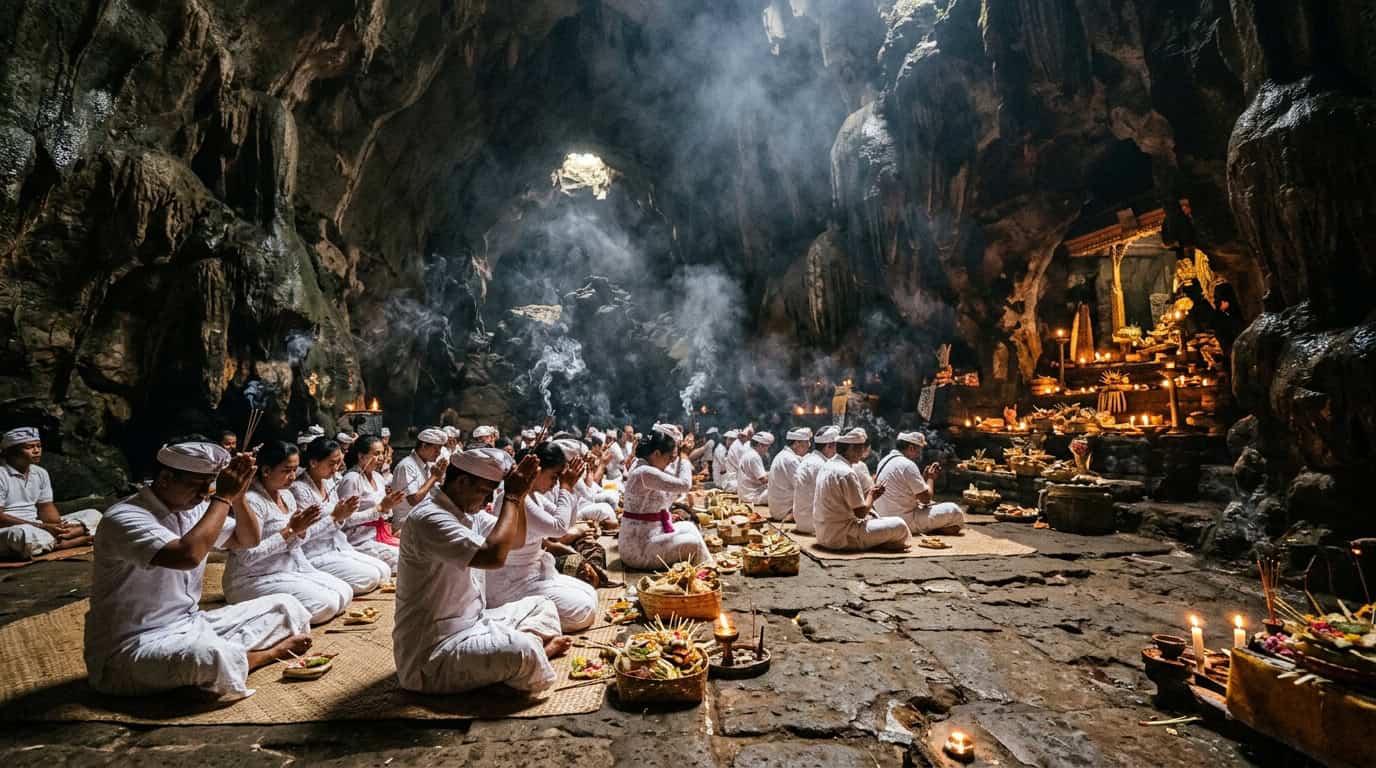
Nowhere is this more evident than at Goa Giri Putri Cave Temple. I squeezed through the tiny, claustrophobic fissure in the limestone rock wall at the entrance, expecting a cramped, dark hole. Instead, the space opened up into a massive, echoing underground cavern capable of holding thousands of worshippers. The smell of damp earth and heavy incense fills the air as priests conduct purification rituals. If you plan to enter sacred spaces like this, you must rent a sarong, cover your shoulders, and observe strict silence and respect.
Logistics: Mainland Preparation and The Crossing
Your journey actually begins on the mainland of Bali, typically in the coastal town of Sanur. Because the fast boats leave early in the morning, organizing your logistics here is crucial to a smooth trip.
Pre-Departure in Sanur
If you are taking an 8:00 AM boat, do not attempt to travel from Canggu or Ubud that same morning—the mainland traffic will likely cause you to miss your departure. Instead, book a room in Sanur the night before. Properties like Seascape Resort Sanur offer excellent proximity to the harbor, meaning you can wake up at 7:00 AM and still make your boat with time to spare.
Sanur also serves as a great place to mentally prepare. We spent our final evening on the mainland eating at Tsune Sanur, an upscale Japanese restaurant with unique coastal views and a floating sushi concept, before getting a traditional deep-tissue massage at Svaha Spa to prep our muscles for the brutal cliff hikes ahead.
The Fast Boat Experience
The journey across the Badung Strait takes roughly 30 to 45 minutes. Boats depart regularly from Sanur, Padang Bai, and Kusamba. You can expect to pay around $15 to $25 USD for a one-way ticket.
The Brutal Reality of Island Transportation
Navigating the terrain is arguably the most defining aspect of any trip here. The infrastructure is decades behind mainland Bali. Roads that appear as thick yellow lines on Google Maps are often narrow, crumbling, single-lane tracks made of broken asphalt and loose gravel.
Option 1: Scooter Rental (High Risk, High Freedom)
Renting a scooter costs about $5 to $8 USD per day directly at the harbor. When I first rented a scooter at Toyapakeh Harbor, I confidently ignored the vendor’s warning about the road to Kelingking Beach. It was a massive error. The sheer inclines, blind corners, and crater-sized potholes require advanced riding skills. Do not rent a scooter here unless you have significant experience riding in Southeast Asia. A minor crash will ruin your trip, and the island lacks a major medical hospital.
Option 2: Hiring a Car and Driver (Recommended)
For $40 to $50 USD per day, you can hire an SUV with a local driver. This is, without question, the smartest way to travel. The drivers understand exactly how to navigate the terrifyingly narrow roads, know the optimal times to visit each site to avoid crowds, and allow you to sit in an air-conditioned cabin while recovering from your hikes.
Option 3: Organized Tours
If you want zero logistical stress, countless operators offer all-inclusive packages that cover your boat transfer, driver, entry fees, and lunch. This is ideal for those on a strict timeline, though it affords you the least flexibility to linger at locations you enjoy.
The Western Circuit: Iconic, Exhausting, and Beautiful
The West side is the epicenter of the island’s tourism. It is where the most recognizable landmarks are located, and consequently, where the heaviest traffic jams occur.
Kelingking Beach
This is the island’s crown jewel. The limestone cliff formation jutting out into the turquoise ocean genuinely looks like a massive Tyrannosaurus Rex drinking from the sea.
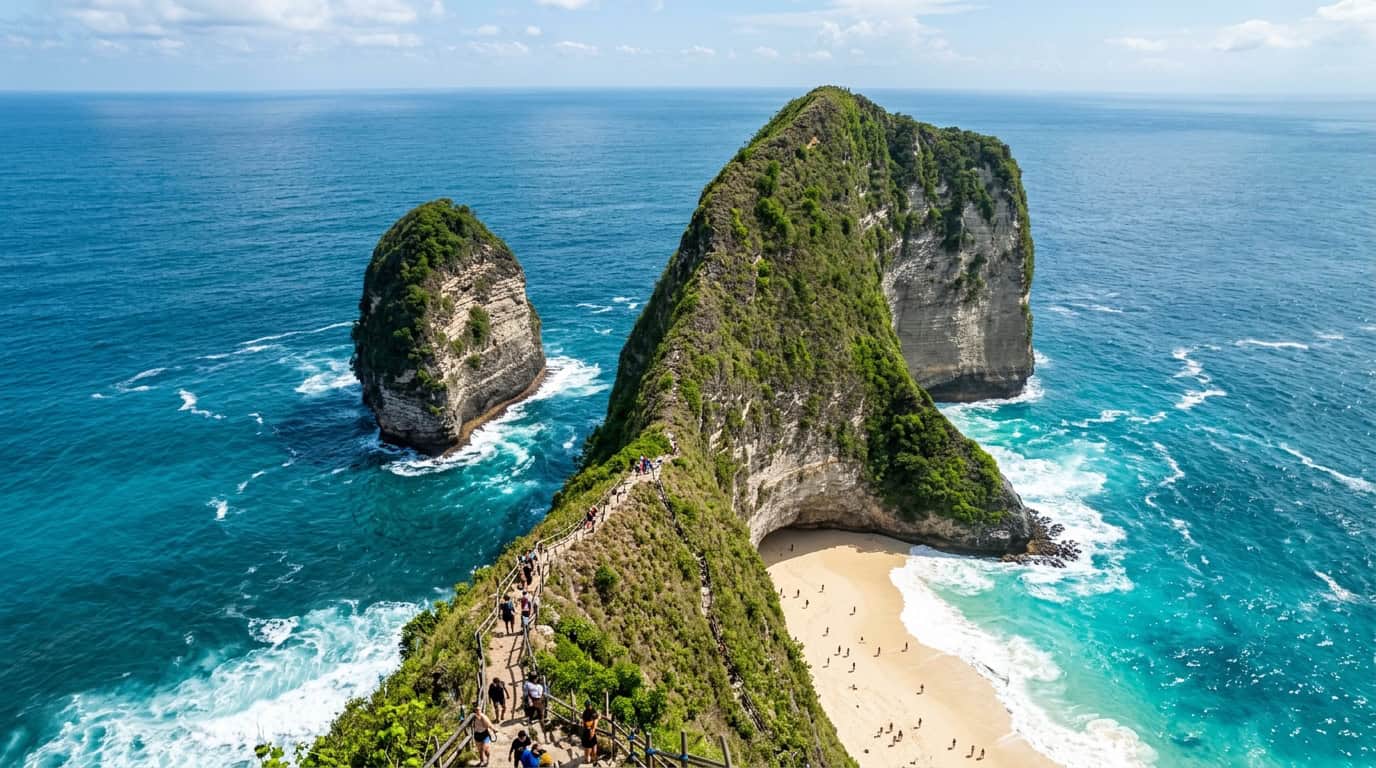
Most visitors snap a photo from the top and leave. However, a rugged, incredibly steep path leads down the spine of the cliff to the pristine white sand below. The descent takes about 45 minutes of agonizing climbing over jagged rocks, gripping rudimentary bamboo railings. The heat radiating off the limestone is oppressive. Do not attempt this climb without a full bottle of water and sturdy shoes. The beach at the bottom is gorgeous, but the waves are violent—swimming here is highly dangerous due to intense rip currents.
Angel’s Billabong and Broken Beach
Located a short drive from Kelingking, these two sites sit adjacent to one another. Angel’s Billabong is a natural infinity pool carved into the coastal rock. During low tide, the water is glassy and calm, allowing visitors to wade inside. However, rogue waves frequently crash over the protective lip during high tide, dragging unsuspecting tourists out to sea. Exercise extreme caution.
Just a five-minute walk away lies Broken Beach. Here, the ocean has carved a massive, perfectly arched tunnel through the rock face, creating a circular lagoon. Swimming is strictly prohibited here; the current is a literal death trap. It is purely a visual spectacle, though an incredibly powerful one.
Crystal Bay
After the grueling hikes, Crystal Bay is the perfect place to finish your Western circuit. It is one of the few easily accessible beaches on the island, with no massive staircases required. The bay is flanked by palm trees and dotted with small warungs selling cold coconuts. The water is generally calm, making it a fantastic spot for afternoon snorkeling.
The Eastern Frontier: Raw Coastal Power
The East side requires more driving time, which acts as a natural filter, keeping the largest crowds at bay. The landscape here feels wider, wilder, and distinctly different from the West.
Diamond Beach and Atuh Beach
These two beaches sit on opposite sides of the same massive parking area. Diamond Beach gets its name from the sharp, geometric limestone rocks that protrude from the water like uncut gems. The staircase carved directly into the white cliff face is visually stunning but extremely steep.
On the other side, Atuh Beach offers a more secluded, isolated cove with softer sands and a smattering of small beach bars. The walk down is equally taxing, but the reward is a quiet stretch of sand that feels worlds away from the chaos of Kelingking.
Teletubbies Hill
Moving inland, the jagged coastlines give way to rolling, vibrant green, terraced valleys. Named for its uncanny resemblance to the landscape from the children’s television show, Teletubbies Hill offers a searing visual contrast to the rest of the island. It is exceptionally beautiful at sunrise when the low-angle light casts deep shadows across the undulating mounds of grass.
Into the Abyss: Marine Life and Diving
Below the surface, the island is internationally recognized as a premier diving and snorkeling destination. The water here is highly nutrient-rich, drawn up from the deep oceanic trenches by powerful currents.
Manta Point
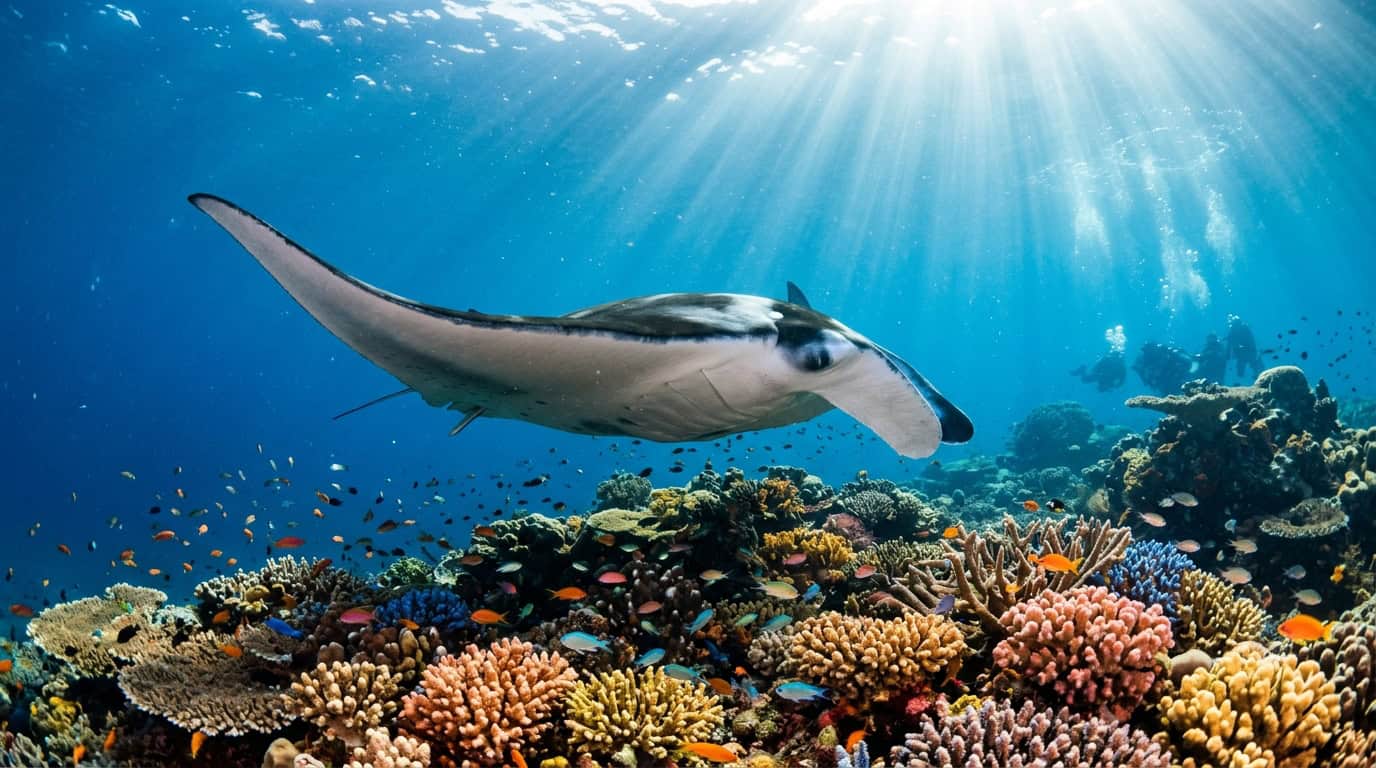
This is a shallow, natural cleaning station where giant oceanic Manta Rays congregate. Snorkelers and divers can float on the surface or sit on the ocean floor while these massive, graceful creatures with wingspans up to 15 feet glide effortlessly overhead. It is a humbling, majestic encounter that you will not easily replicate elsewhere.
SD Point and Crystal Bay Diving
For certified scuba divers, SD Point offers thrilling drift dives where you can simply let the prevailing current carry you past miles of healthy coral gardens, sea turtles, and reef sharks.
If you visit during the dry season, specifically between July and October, the deep, cold waters of Crystal Bay become one of the few places on earth where you can reliably spot the elusive Mola Mola, or oceanic sunfish. These bizarre, disc-shaped fish can weigh over 2,000 pounds and rise from the freezing depths to be cleaned by smaller reef fish.
Cost and Value: A Realistic Budget Breakdown
Nusa Penida accommodates a remarkably wide spectrum of budgets. Whether you are a backpacker stretching every dollar or a honeymooner seeking luxury, the island scales accordingly.
Who Should Visit (And Who Should Not)
- Adventure seekers who enjoy physical exertion, steep climbs, and earning the reward through sweat.
- Marine enthusiasts looking for world-class scuba diving and snorkeling encounters.
- Nature photographers drawn to dramatic cliffs, powerful seascapes, and strong color contrast.
- You have severe mobility issues, since many major attractions require steep and uneven stair access.
- You expect Seminyak-style luxury infrastructure; power outages and rough roads are still common.
- You suffer from severe motion sickness, because both the fast boat and inland drives can be rough.
Common Mistakes to Avoid
Even seasoned travelers falter here due to a lack of specific preparation.
1. Packing Inappropriate Footwear
We packed only flip-flops for our first day—a massive error when trying to navigate the razor-sharp limestone paths down to Diamond Beach. Open-toed shoes will leave you with cut feet and zero traction on the dusty, steep inclines. Bring legitimate running shoes or specialized hiking sandals.
2. Underestimating Travel Times
Looking at a map, Kelingking Beach and Crystal Bay appear right next to each other. In reality, the routing requires driving far inland on terrible roads before cutting back to the coast. A distance of 10 kilometers can easily take 45 minutes to drive. Do not overpack your daily itinerary; pick two major locations per day.
3. Disrespecting the Sun
The tropical sun radiating off the exposed white limestone cliffs is unforgiving. There is virtually no natural shade at the major viewpoints. Failure to pack high-SPF sunscreen, a wide-brimmed hat, and UV-rated sunglasses will result in severe heat exhaustion before noon.
Frequently Asked Questions
Is Nusa Penida safe for tourists?
Generally, yes, but the primary dangers are environmental rather than criminal. Violent crime is virtually non-existent. The real risks stem from riding scooters on terrible roads, getting caught in strong ocean rip currents, or suffering from heat stroke. Exercise common sense, hire a driver, and stay away from cliff edges.
Can I swim at Kelingking Beach?
While you physically can enter the water at the bottom of the Kelingking cliff, it is highly discouraged unless you are an exceptionally strong ocean swimmer. The undertow is incredibly powerful, the waves break violently directly onto the sand, and there are no lifeguards on duty.
Do I need a visa specifically for the island?
No. Nusa Penida is part of the Bali province in Indonesia. Your standard Indonesian tourist visa, including a Visa on Arrival obtained when landing at Ngurah Rai International Airport (DPS), covers your visit to the island.
Is the island family-friendly for young children?
It depends on the children. Teenagers will likely love the adventure. However, for toddlers and very young children, the island is highly challenging. The long, hot car rides, lack of safety railings on massive cliffs, and rough ocean conditions make it a stressful environment for parents of young kids.
The Final Verdict
Nusa Penida is not a manicured resort destination; it is a raw, demanding, and incredibly powerful environment. By allocating the proper time—at least three days—respecting the dangerous road conditions, and venturing past the viral photo spots, you will discover an island that feels wonderfully untamed.
Hire a local driver, pack your sturdiest shoes, withdraw plenty of cash, and prepare to be humbled by the sheer scale of the cliffs and the ocean that surrounds them. Your legs will ache by the time you board the ferry back to Sanur, but the visual memories you collect will be entirely worth the physical toll.
If remote island planning is your thing, you can also compare this experience with Gili Meno Travel Guide or browse more aspirational escapes in Extraordinary Travel Experiences You Must Try Before You Die.