
If you want to navigate the globe smoothly this year, relying on outdated advice will actively sabotage your itinerary, which is why mastering modern 2026 travel tips is absolutely non-negotiable. The rules of international exploration have fundamentally shifted over the past few years. Airline pricing algorithms have abandoned old patterns, entry bureaucracy has tightened significantly, and global inflation has transformed the cost of casual tourism. Strategies that worked flawlessly five years ago—like booking airfare on a Tuesday night or exchanging physical currency at the airport—will now drain your bank account and leave you stranded. To protect your time and money, you must adopt a highly intentional, data-driven approach to every aspect of your journey.
If you’re building a broader planning stack, this guide also pairs naturally with
Best AI Travel Planners
and
Solo Travel Guide
for a more complete pre-trip workflow.
Quick Summary
- Book Early Morning Flights: Expedia data shows flights departing after 9:00 p.m. have a 57% higher cancellation rate. Always take the first flight out.
- Verify New ETA/ETIAS Rules: Do not assume your passport guarantees entry. By May 2026, most travelers will require digital authorizations for the UK and the European Schengen Zone.
- Implement the 5-Block Rule: Never eat within five blocks of a major tourist monument to avoid inflated prices and low-quality, multi-language menus.
- Decline Dynamic Currency Conversion: Always choose to be charged in the local currency at foreign credit card terminals to secure the fair, mid-market exchange rate.
- Pivot to Beta Destinations: Swap overcrowded alpha cities like Venice or Rome for secondary beta cities like Verona to secure better pricing and authentic interactions.
The Direct Answer: How to Travel Successfully in 2025
To engineer a stress-free trip in 2026, you must execute four specific actions before you ever leave for the airport. First, audit your travel documentation immediately; the era of frictionless border crossings is ending, and you must apply for mandatory electronic travel authorizations like the UK’s ETA or Europe’s ETIAS well in advance. Second, abandon third-party booking platforms and purchase your non-stop airfare directly from the airline to guarantee prioritized customer service during inevitable delays.
Third, secure a premium travel credit card with zero foreign transaction fees, and pair it with a local eSIM data plan for your smartphone to ensure continuous global connectivity without exorbitant roaming charges. Finally, pivot your itinerary away from overcrowded primary tourist hubs and toward secondary beta cities to stretch your budget and escape the exhausting crowds. Master these core fundamentals, and you will effectively eliminate 80% of the logistical disasters that ruin modern vacations.
Readers planning city-heavy routes may also want
Getting Around Bangkok
and
Ho Chi Minh City Travel Guide
to compare how these tactics apply on the ground.
Flight Mastery and Transit Protocols
Securing affordable, reliable transit is the foundation of any successful itinerary. The airline industry operates on hard data, and travelers who understand these metrics save hundreds of dollars.
The Statistics of Flight Cancellations
Nobody wants to sleep on an airport floor, but your departure time directly dictates your risk level. According to the 2026 Expedia Air Hacks report, travelers should universally target the first flight out in the morning. The data is completely unambiguous: flights scheduled to depart after 9:00 p.m. face a massive 57% higher chance of being canceled compared to early morning routes. Weather systems tend to destabilize later in the day, and aircraft delays cascade throughout the network.
I learned this lesson the hard way when my 10:00 p.m. connection out of Newark was canceled due to a missing flight crew. It forced me to sleep on a vinyl bench near a closed food court while morning passengers breezed past me hours later. Take the 6:00 a.m. flight, grab an overpriced coffee, and sleep on the plane.
The New Rules of Booking and Routing
Erase the old myth that Tuesday at midnight is the magical time to buy airfare. Current airline algorithms show that Sunday is officially the cheapest day to purchase tickets. As for the day you actually fly, Saturday remains the most economical option for domestic routes, while Thursday departures will save you the most money on international flights.
Booking timelines have also crystallized. For domestic flights within the United States, the absolute lowest price point statistically hits 38 days before departure. For international travel, book as early as possible. While last-minute inventory dumps do occur 18 to 29 days before departure, the honest downside to these late deals is that the routing is usually brutal. You might save $300, but you will pay for it with an eight-hour layover in a secondary airport.
Expert travel advisors strongly recommend booking flights directly through the airline’s website rather than using third-party aggregators. When a flight is canceled, airlines prioritize rebooking direct customers first, leaving third-party buyers stranded on hold with offshore customer service lines. Furthermore, paying extra for a non-stop flight is no longer a luxury; it is a strategic splurge that removes the connecting variables that lead to lost luggage and missed connections.

Destination Strategy: The Rise of Beta Cities and JOMO
The most critical decision you make is not just where you are going, but specifically what type of environment you are subjecting yourself to.
Prioritize Beta Destinations
Veteran travel journalists are heavily advocating for bypassing primary, highly saturated tourist hubs in favor of secondary or beta cities. This approach serves as a discernible mitigation strategy against global overtourism while providing a superior experiential yield.
Instead of paying a massive premium to fight shoulder-to-shoulder crowds in Venice, pivot your base to Verona. Instead of battling the density of Nashville, explore the music scene in Memphis. Beta cities feature local economies that cater to actual residents rather than tourists, resulting in significantly better restaurant quality and lower hotel pricing. You can still visit the alpha city, but do it as a day trip while keeping your luggage and sanity secure in a quieter basecamp.
The 2025 Italy Jubilee Warning
If you are traveling to Italy in 2025, you must plan around the Jubilee year. This religious milestone will bring unprecedented millions of pilgrims into Rome. While it offers a unique opportunity to witness historic celebrations, the sheer density of crowds will overwhelm the city’s infrastructure. Travel advisors suggest that unless you are specifically attending the Jubilee, you should bypass Rome entirely this year and focus your Italian itinerary on rural provinces or the quieter coastlines of the south.
Embracing the Crossover Month
September operates as the ultimate cross-over period for global travel, bridging the gap between the peak summer season and unpredictable late-autumn weather. Children return to school, resulting in directly cheaper travel fares and vastly reduced crowd sizes, yet the weather remains balmy before seasonal closures take effect. The only caveat to September travel is that you must monitor regional weather patterns closely. While the Mediterranean is usually perfect, the Caribbean is deep into hurricane season.
Financial Safeguards: Stop Wasting Your Money
Managing money across borders requires specific tactics to avoid exchange traps, dynamic algorithms, and hidden fees.
The Dynamic Currency Conversion Trap
When you use your credit card at a foreign restaurant or retail shop, the point-of-sale terminal will often flash a seemingly helpful prompt asking if you would like to be charged in your home currency (USD) or the local currency (Euros, Yen, and so on).
Always, without exception, choose the local currency. If you choose USD, the foreign merchant’s bank dictates the exchange rate through a process called Dynamic Currency Conversion (DCC). They will give you an abysmal rate and pocket the difference. If you select the local currency, your home bank processes the conversion, guaranteeing a fair, mid-market exchange rate.
Unconventional Discounts and Hacks
Do not leave free money on the table. Implement these two highly effective financial strategies:
The AARP Hack: There is absolutely no age minimum to join AARP. Anyone of any age can purchase a membership for roughly $12 a year and immediately access massive discounts on British Airways flights, international hotel chains, and rental cars.
VAT Refunds: If you buy expensive goods in the European Union (typically triggering over a $50 to $100 threshold depending on the country), ask the retailer for a Value Added Tax (VAT) refund form. You must present these forms and the unused goods to customs officers at the airport before flying home, but recovering 10% to 20% of your purchase price is well worth the extra 45 minutes in line.
The Insurance Debate: Standard vs. CFAR
The 2025 travel landscape is defined by geopolitical shifts and extreme weather, making travel insurance a hotly debated topic. There are two distinct schools of thought. Some travel experts take a contrarian view: if you have the cash reserves to absorb the cost of a lost flight or hotel booking without severe financial distress, standard travel insurance is largely a waste of money due to its heavy exclusions. However, for complex international trips, experts agree that medical and evacuation coverage is mandatory. Standard domestic health insurance rarely covers international medical flights, which can exceed $50,000. If you are booking a high-cost trip months in advance, skip the standard policy and purchase Cancel For Any Reason (CFAR) insurance. While it typically only reimburses 50% to 75% of your costs, it allows you to back out of a trip simply because you feel anxious about changing global events—something standard policies will explicitly deny.
Dining and Local Culture: The 5-Block Rule
Where you eat determines a massive percentage of your overall travel satisfaction and budget.
Renowned budget travel experts advocate strictly for the 5-Block Rule. There is an invisible boundary exactly five blocks away from any major tourist attraction. Restaurants immediately adjacent to the Eiffel Tower, the Colosseum, or Times Square do not have to rely on repeat local business; they survive entirely on foot traffic from exhausted tourists. Consequently, their food quality is low, and their prices are heavily inflated.
Once you walk five blocks away, the crowds thin out. Establishments in this zone rely on local residents to survive, meaning the food must be authentic and priced reasonably. A clear indicator of a tourist trap is a menu printed in four different languages with large glossy photographs of the food. Walk past it.
The Psychological Phrasing Hack
When attempting to find authentic food, how you ask a local for directions changes everything. Do not ask a hotel concierge or shopkeeper, “Where should I eat?” This prompts them to mentally filter for what is famous or accessible for tourists, pointing you right back to the crowded squares. Instead, ask, “Where do you eat?” I tested this on a barista in Lisbon last year. The moment I changed my phrasing, she stopped pointing at the map, wrote down the name of a tiny neighborhood joint two miles away, and told me exactly what pork sandwich to order. It remains the best meal I’ve had in Portugal.

Bureaucracy, Safety, and Smart Tech
Preparation mitigates disaster. The administrative landscape of travel is shifting rapidly, and ignorance will result in denied boarding.
2025 Entry Requirements (ETA and ETIAS)
Bureaucracy is tightening globally. Do not assume your powerful passport grants you automatic, frictionless entry anymore. In 2025, the United Kingdom requires an ETA (Electronic Travel Authorisation) for visa-exempt foreign travelers, requiring an online application and small fee prior to boarding your flight.
By mid-2025, the European Union is slated to roll out a similar system known as ETIAS for the Schengen Zone. You must check the specific entry requirements of your destination 60 days before your flight. These authorizations are entirely digital, but if you show up to the airport without one linked to your passport number, the gate agent will turn you away.
On-The-Ground Security and Connectivity
When traveling internationally, enroll in the U.S. State Department’s Smart Traveler Enrollment Program (STEP). It is a free service that registers your trip with the nearest embassy, ensuring they can locate and assist you during a geopolitical crisis or natural disaster. For daily navigation, abandon your home cellular provider’s international roaming pass, which often charges $10 a day for aggressively throttled speeds. Instead, install a local eSIM before your plane even takes off. You land, toggle the cellular profile on your phone, and instantly have cheap, high-speed data to pull up Google Maps for public transit navigation.
Accommodation Tactics and Smart Packing
Where you sleep and what you carry dictate your daily mobility.
Hybrid Hotels and Keyword Searching
When booking accommodations, bypass the standard star-rating system. Instead, go to the review section of a hotel and use the keyword search function to filter for the word noise. The money you save by booking an ultra-budget hostel is almost always paid for in lost sleep due to thin walls, which exacerbates jet lag and ruins your trip.
If you are traveling with a family, look for hybrid accommodations—standalone cottages or villas located on the grounds of luxury hotels. This provides the privacy of an Airbnb while maintaining access to premium hotel infrastructure such as spas, security, and dining without the burden of domestic chores.
Odd Packing Hacks for 2025
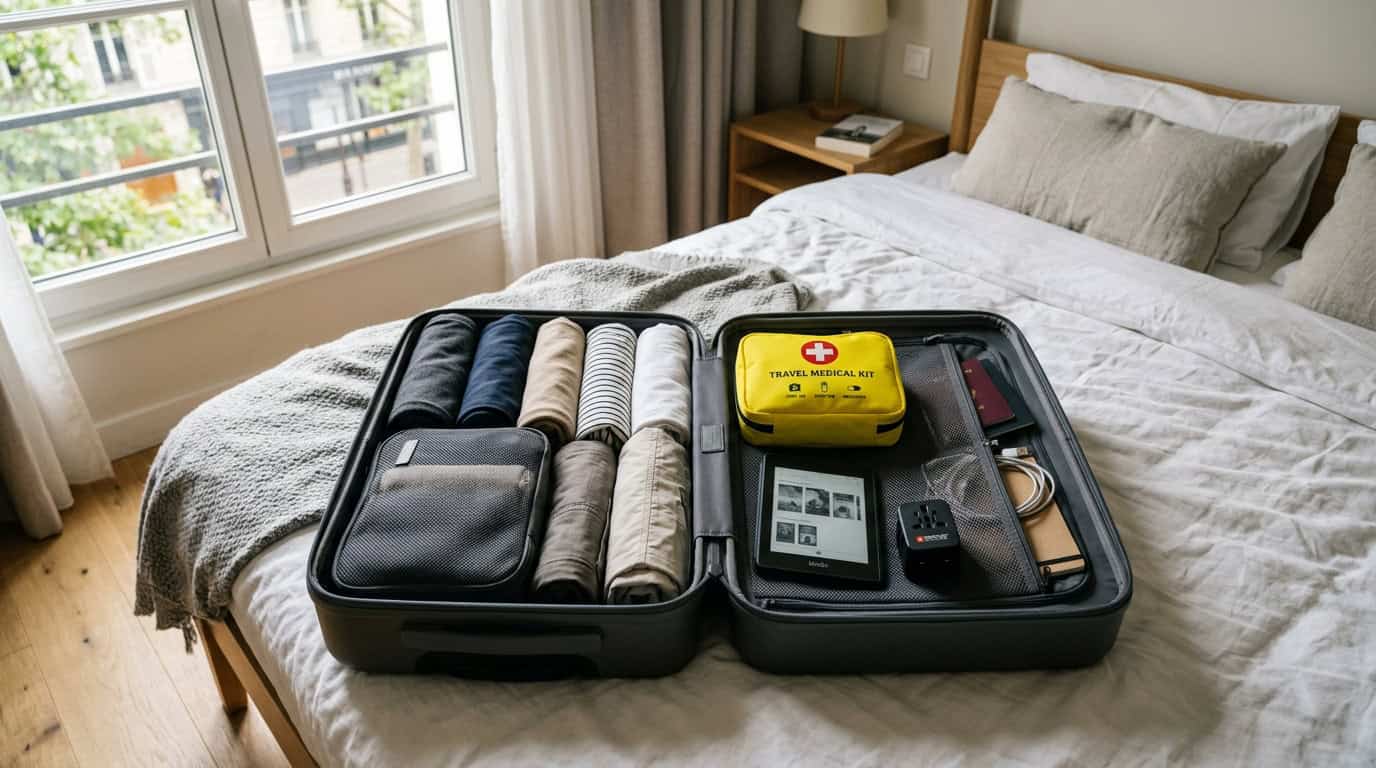
Overpacking restricts your movement and leaves you vulnerable to airline luggage catastrophes. Stick to a carry-on when possible, and deploy these specific hacks:
The Clip Hanger Trick: Use the clip hangers found in standard hotel closets to securely pin your room’s blackout curtains together, preventing that sliver of morning street light from disrupting your sleep.
Latex Balloons: Stretch standard latex balloons over the tops of your liquid toiletries before screwing the caps back on. This creates an airtight seal that completely prevents pressure-induced spills in your luggage.
Mini-Carabiners: Keep two small carabiners on your backpack. Use them to lock the zippers together when walking through dense pedestrian zones, effectively rendering your bag pickpocket-proof.
Cost vs. Value: The Financial Impact of Preparation
Failing to implement these 2025 travel tips has a measurable financial cost. Here is a realistic breakdown of how small mistakes compound into massive expenses on a standard two-week international trip.
Who Should Use These Strategies (And Who Should Not)
This approach is ideal for:
Independent travelers building their own itineraries rather than relying on massive, restrictive tour buses.
Budget-conscious individuals who want to reallocate funds from banking fees and tourist traps into authentic culinary experiences.
Travelers visiting major urban centers or undertaking multi-city European trips where maximum mobility is a distinct operational advantage.
Digital nomads and extended-stay remote workers who need to blend into local economies seamlessly.
You might want to skip some of this if:
You are traveling to a remote, single-location beach resort where you will not leave the property for seven days. In this scenario, checking a massive bag is perfectly acceptable since you don’t have to drag it across public transit.
You are traveling with infants or small toddlers. The carry-on-only rule and fast-paced public transit navigation become virtually impossible when dealing with strollers and portable cribs.
Common Mistakes to Avoid
Even highly prepared travelers fall into psychological traps. Avoid these two specific errors:
Mistake 1: The Over-Scheduling Trap
Novice travelers calculate the total cost of their flight and try to maximize the return on investment by booking an activity for every waking hour. This leads directly to burnout. When I visited Florence last year, I made the mistake of trying to see the Uffizi, the Accademia, and the Duomo in a single 36-hour window. The resulting exhaustion ruined the following two days of the trip. Build intentional downtime into your itinerary. Pick one major activity for the morning, and leave the afternoon completely open to wander.
Mistake 2: Ignoring Local Tourism Offices
Many experienced travelers view local municipal tourism offices as cheesy or irrelevant. This is a massive mistake. These offices are staffed by lifelong locals who hold the keys to exclusive regional discounts, unadvertised free walking tours, and authentic recommendations. Walking into a local office and asking for a neighborhood map is one of the fastest ways to bypass digital algorithms and find genuine local experiences.
Frequently Asked Questions
How can I proactively fight jet lag before I arrive?
Stop relying on guesswork and download a science-based app like Timeshifter. You input your flight itinerary, and the app generates a personalized, hour-by-hour schedule based on your circadian rhythm. It tells you exactly when to seek bright light, when to avoid caffeine, and when to sleep on the plane, allowing you to bypass the worst effects of timezone transitions.
Are modern hostels actually safe and clean for older travelers?
Absolutely. The perception of hostels as dirty, youth-only party hubs is heavily outdated. Modern hostels feature co-working spaces, private lockable bedrooms, and ensuite bathrooms. They cater heavily to digital nomads and older solo travelers, offering the privacy of a budget hotel combined with superior social networking opportunities in the lobby.
Do I need to carry physical cash in 2025?
Yes, but only a small amount. While the globe has largely shifted to contactless payments, you still need the equivalent of $50 to $100 in local currency upon arrival. This allows you to pay for small street vendor purchases, public transit tickets in smaller towns, and hotel tipping without aggressively hunting for an ATM while jet-lagged.
What happens if I forget to apply for an ETIAS or ETA?
If your destination requires a digital travel authorization in 2025 and you fail to secure one, you will be denied boarding at your departure airport. The airlines electronically verify your passport status at check-in. While some approvals process in minutes, others can take up to 72 hours, meaning you cannot rely on filling out the application while standing in the security line.
The Bottom Line
Implementing these essential 2025 travel tips transforms international trips from stressful logistical hurdles into seamless, enriching experiences. By prioritizing early morning non-stop flights, escaping the crowds via beta destinations, understanding foreign transaction mechanics, and protecting your vital documents, you remove the friction that derails most vacations.
Prepare for the worst-case bureaucratic scenarios at home, build flexibility into your daily itinerary, and step onto the plane knowing you have engineered a flawless journey. Your next immediate step is simple: check your passport expiration date, research the ETA/ETIAS requirements for your target destination, and apply for a premium travel credit card.
For readers who want to turn these concepts into real itineraries, continue with
Italian Road Trip Guide,
Getting Around Bangkok,
and
Best AI Travel Planners.