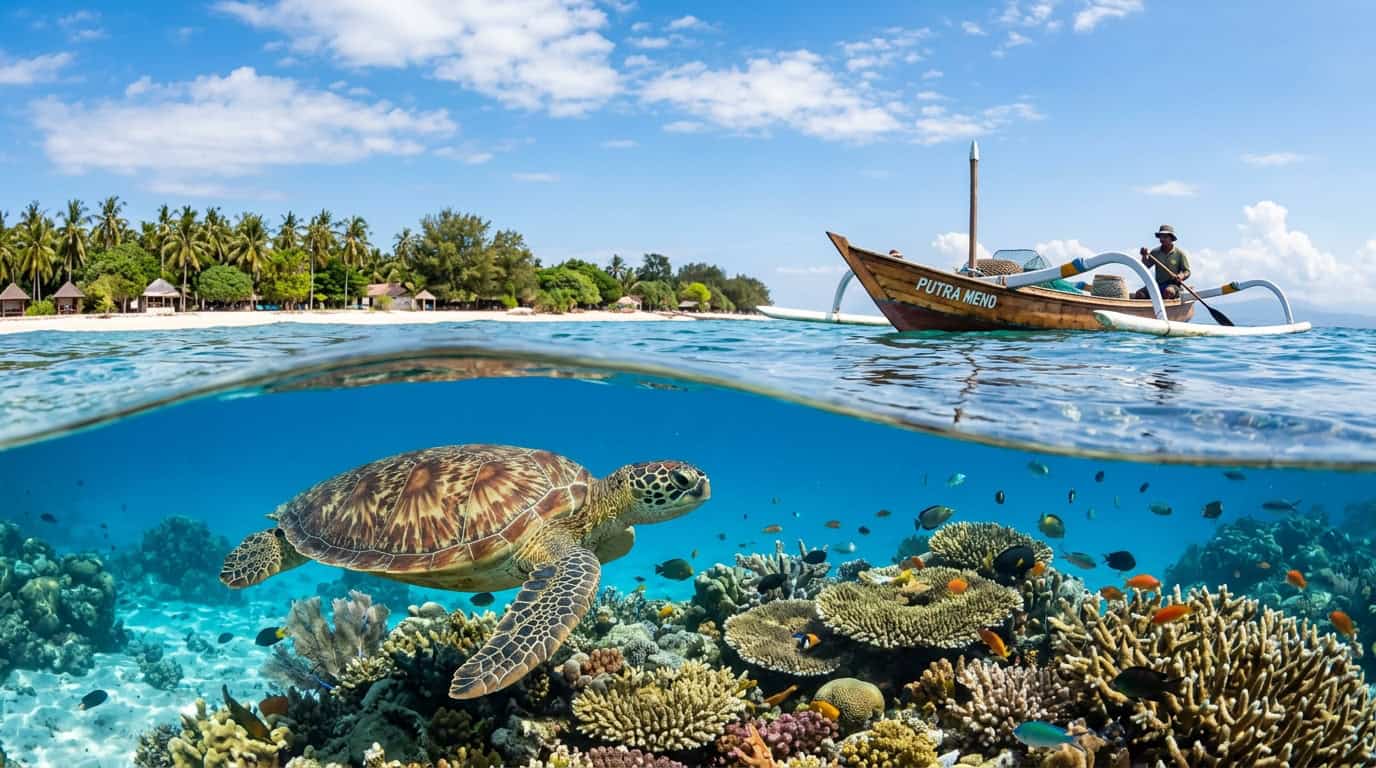
Properly planning your trip for snorkeling with turtles in Gili Meno requires more than just showing up at the beach with a rented mask and hoping for the best. While this tiny, motor-vehicle-free island off the coast of Lombok, Indonesia, genuinely deserves its reputation as the “Sea Turtle Capital” of the region, actually finding the turtles, avoiding the massive tourist crowds, and staying safe in unpredictable ocean currents takes a bit of localized strategy.
I recently spent time mapping the reefs around this island, and the difference between an overcrowded, frustrating morning and a peaceful, private swim alongside a 1.5-meter green sea turtle comes down to timing, negotiation, and knowing exactly where to enter the water. This comprehensive guide breaks down everything you need to know about marine life encounters, boat charters, and navigating the island’s unique logistics.
Quick Summary
The Best Spot is Free: You do not need an expensive boat tour to see sea turtles. The best feeding ground, Turtle Paradise, is accessible straight off the northeast beach.
Beat the Statue Crowds: The famous ‘Nest’ underwater statues become a chaotic tourist trap by 9:00 AM. Negotiate a private boat to leave no later than 7:30 AM, or swim out at 8:00 AM for clear photos.
Mind the Currents: Gili Meno has distinct, opposing currents. The West side pulls strongly North, while the East side pulls South. Flippers are strictly mandatory for safety.
Take the Slow Boat: When island-hopping from Gili Trawangan, skip the $6.50 fast boat. The $1.50 public slow boat is larger, feels safer, and only adds 10 minutes to your transit.
Health and Safety First: Unlike Bali, the Lombok region carries a malaria risk, compounded by Gili Meno’s inland saltwater lake. Bring high-concentration DEET and consult a doctor about prophylaxis.
The Direct Answer: How to Find the Turtles
If you want the highest probability of swimming alongside sea turtles with the least amount of friction, walk to the Northeast coast of Gili Meno to a spot locally dubbed Turtle Paradise. You do not need to book a tour or hire a guide.
Simply walk north from the main arrival pier until you pass the heaviest concentration of cafes. Wade about 20 to 30 meters out into the water during mid-to-high tide. Look for the patches of sea grass on the sandy bottom—this is where massive Green Sea Turtles congregate to feed in shallow water (typically 1 to 4 meters deep).
To safely and successfully execute this, you must enter the water between 7:30 AM and 10:00 AM. By midday, once the turtles are satiated, they retreat into the deeper ocean drop-offs where only scuba divers can reach them. Bring your own mask to save money, wear water shoes to protect against the dead coral near the shoreline, and simply float motionless over the seagrass beds.
Why Gili Meno is the Ultimate Snorkeling Destination
When planning a trip to the Gili Archipelago, you must choose between three distinct islands. Understanding their differences is critical for setting your snorkeling expectations.
Gili Trawangan (Gili T) is the largest and most heavily trafficked. It is famous for its nightlife, massive beach clubs, and younger demographic. While it has a decent “Turtle Point” on its northeast coast, the heavy boat traffic makes snorkeling here feel chaotic and rushed.
Gili Air is the middle ground. It offers a laid-back atmosphere with accessible shallow waters perfect for absolute beginners. However, much of the shallow coral around Gili Air has been degraded or destroyed over the years, making it visually disappointing for experienced snorkelers.
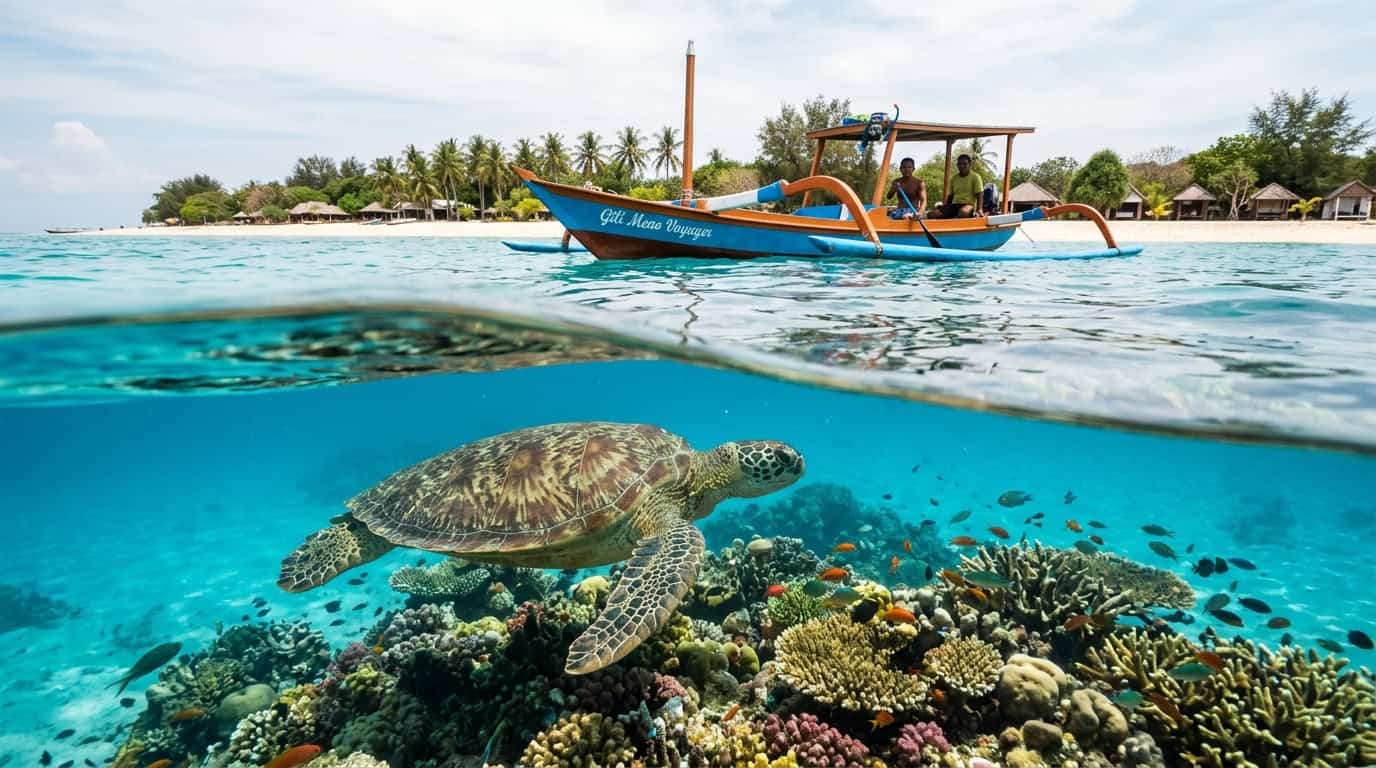
Gili Meno is the smallest, quietest, and most pristine of the three. Measuring just two kilometers long and one kilometer wide, you can walk around the entire island in a few hours. It features the healthiest coral reefs in the archipelago, the highest concentration of resident turtles, and the famous underwater statues. Because motorized vehicles are strictly banned (locals use bicycles and horse-drawn carriages called cidomos), the island maintains a peaceful, slow-paced atmosphere that perfectly complements underwater exploration.
The 4 Best Snorkeling Spots Detailed
If you opt for a local boat charter, or if you plan to hike around the island’s perimeter to swim out from various beaches, these are the four distinct underwater zones you need to prioritize, working clockwise from the West.
1. The ‘Nest’ Underwater Statues (West Coast)
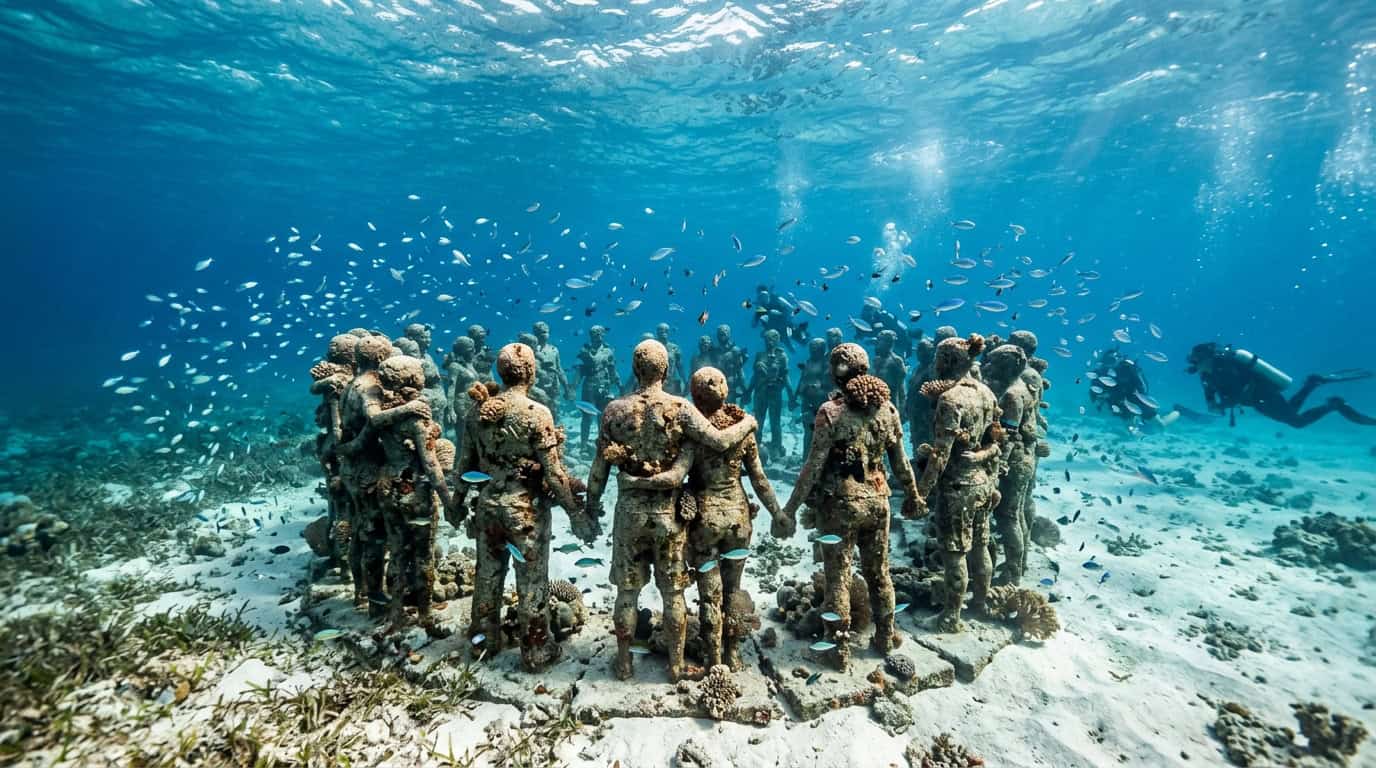
Located just 15 meters off the beach in about 4 meters of sandy water, this is the most famous site in the Lombok region. Commissioned by the BASK resort and created by renowned British sculptor Jason DeCaires Taylor, it features 48 life-size human figures arranged in a symmetrical circular design. The installation symbolizes the circle of life and acts as an artificial reef to encourage coral regeneration.
When I approached the famous ‘Nest’ statues at 9:30 AM, I learned a difficult lesson: I found a chaotic soup of neon life jackets, selfie sticks, and kicking fins. It is a massive tourist trap by mid-morning, as dozens of large tour boats from Gili Trawangan and mainland Lombok converge on this tiny patch of sand.
Strategic Advice: To truly appreciate the haunting beauty of these statues, you must beat the crowds. If you are staying on Gili Meno, look for the large white BASK hotel sign on the western beach, leave your towel on the sand, and swim 30 meters straight out at exactly 8:00 AM. You will likely have the statues entirely to yourself before the commercial boats arrive at 8:45 AM.
2. Turtle Paradise (North-East Coast)
As mentioned in the direct answer above, this is the undisputed premier location for accessible wildlife. The ocean floor here features a mix of seagrass beds and coral blocks. Loud motorized boat traffic occasionally scares the turtles into deeper water, so quiet, solitary swimmers floating gently on the surface have an incredibly high success rate.
3. Coral Garden & Meno Wall (East Coast)
Stretching south from the main pier, the Coral Garden boasts an incredibly dense and healthy sea bed. The variety of coral species here is staggering. Within a single 50-meter drift, you can spot Table, Stoney, Branch, Brain, Blue Ridged, Cauliflower, and Rose-shaped Lettuce corals.
Because a distinct, consistent current runs South along the East Coast, the best strategy is to enter the water near the harbor and simply let the water pull you effortlessly southward over the Coral Gardens, eventually exiting the water near the southern tip of the island. This area features a steep drop-off known as the Meno Wall, which is heavily favored by local scuba divers.
4. Bounty Wreck (South-West Coast)
Situated just off a sharp underwater drop-off at a depth of 7 to 10 meters, the Bounty Wreck is a sunken pontoon structure. Because of the depth, it is primarily considered a free-diving or scuba site rather than a shallow snorkel location. The flat steel body of the wreck is heavily encrusted with soft corals and swaying seaweed. Large turtles frequently use the dark, quiet corners of the wreck as resting places.
Safety Warning: The currents on the West side of the island are notoriously strong and push consistently Northward. You will be engaging in “drift snorkeling” here—letting the ocean carry you along the wreck rather than trying to swim against the heavy flow.
The Marine Biology: What You Are Looking At
The primary draw is the sea turtles, and you are likely to encounter two distinct species in these waters.
Green Sea Turtles are the most common and the largest. They are gentle giants that spend their mornings grazing on the shallow seagrass beds. You can identify them by looking at their heads: they have exactly two distinct scales between their eyes.
Hawksbill Turtles are a rarer, more spectacular sight. Ranked as “Critically Endangered” by the IUCN, their presence in Gili Meno indicates a recovering ecosystem. They have a distinct, bird-like beak used for extracting sponges from the coral reef, and they possess four scales between their eyes.
Beyond turtles, the biodiversity is excellent. Keep an eye out for Oscellaris Clownfish living in Saddle Carpet Anemones, massive Giant Moray Eels hiding in the coral crevices, and colorful Phyllidia Varicosa Nudibranchs (sea slugs) clinging to the rocks. I was even fortunate enough to spot a rare Zebra Lionfish just 15 meters off the eastern beach, though you must keep a highly respectful distance from their venomous spines.
Understanding the Logistics: Boats, Fees, and Haggling
One of the biggest decisions you will make is how to access the water. You have three primary options.
Option 1: The Group Tour (Not Recommended)
When you step off the pier, you will see signs advertising organized group snorkeling tours ranging from $15.00 to $60.00 USD per person. These boats pack 15 to 25 tourists onto a single deck and run on strict, rushed schedules. Furthermore, if you book at a local physical stand rather than online, you often fall victim to the “hidden fee” trap, where you are suddenly asked to pay extra cash to rent fins or a life jacket once you are already on board.
Option 2: The Private Local Charter (Highly Recommended)
Walk up to the local boatmen lounging near the harbor. The standard opening asking price for a private local charter is usually around $40.00 USD. With polite, friendly negotiation, you can secure a private, three-hour boat tour covering three distinct snorkel spots for roughly 300,000 IDR (about $18.00 USD). Having a private boat means you dictate the pace. If you want to spend an hour staring at the Nest statues at 7:30 AM before the crowds arrive, you can.
Option 3: DIY Shore Snorkeling (Free)
As previously mentioned, simply walking onto the East coast beach, donning your gear, and wading out 20 to 30 meters will put you right on top of the reef structure. This is highly economical and allows you to snorkel on your own biological clock.
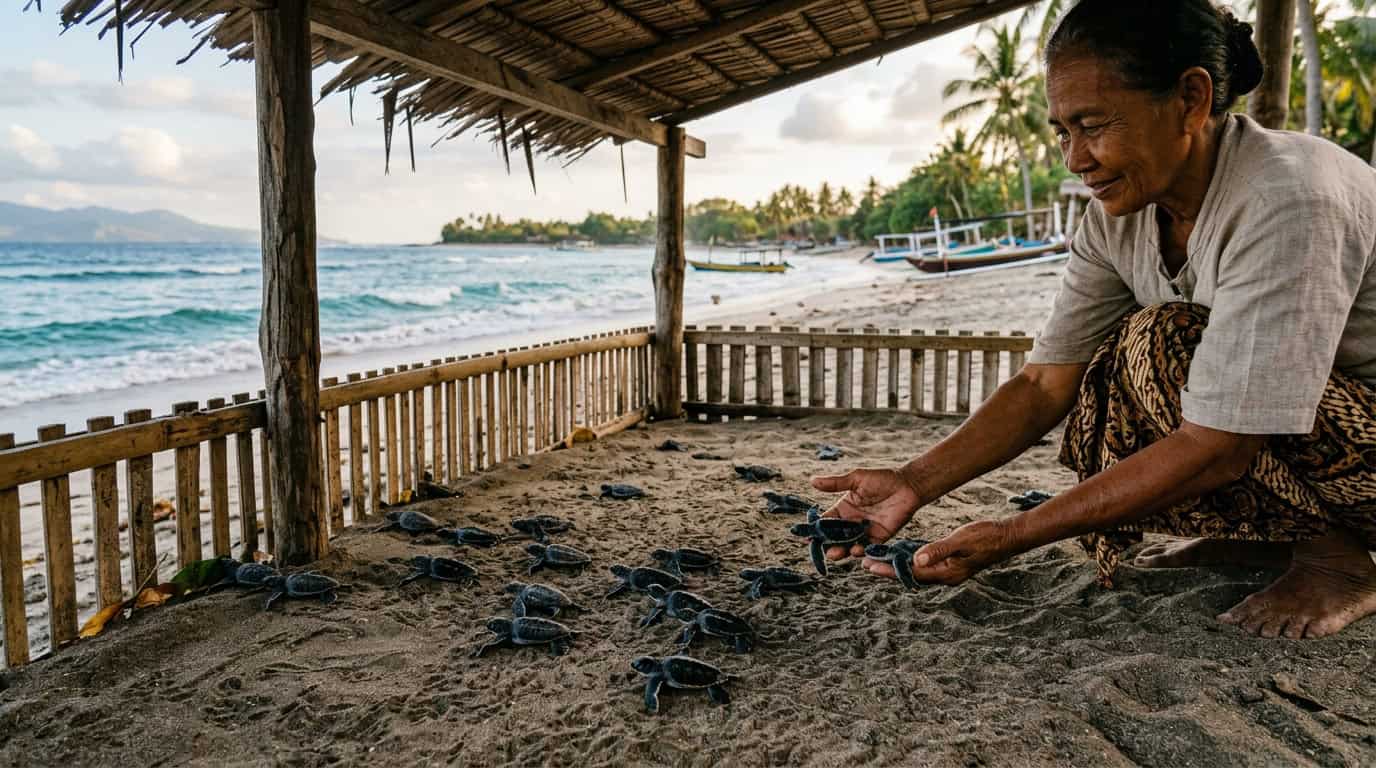
The Gili Meno Sea Turtle Sanctuary
While swimming with adult turtles is an incredible experience, understanding how they reach adulthood is sobering. Dedicating 30 minutes to the grassroots Gili Meno Sea Turtle Sanctuary is an essential part of the trip.
In the wild, sea turtle hatchlings face insurmountable odds. Only about 1 in 1,000 survives to adulthood. They are decimated by local predators, poachers who steal eggs for the black market, commercial fishing nets, and the ever-growing threat of plastic pollution in the ocean.
The sanctuary is not a polished, commercialized tourist attraction with gift shops. It is a modest community initiative. Caretakers pay local fishermen to bring them discovered eggs rather than selling them to markets. These eggs are placed in secure, shaded sand enclosures to incubate. Once hatched, the babies are moved into specialized water tanks, fed, and monitored until they develop the physical strength required to battle ocean currents.
The facility operates strictly on a cash-only basis. Ensure you bring small Rupiah notes. The recommended donation is between 50,000 and 100,000 IDR (about $3.50 to $7.00 USD). Every Rupiah goes directly into buying turtle feed and maintaining the water pumps.
Getting There: Navigating the Indonesian Ferries
Reaching Gili Meno requires a multi-step journey. Because it is the quietest of the three islands, it has the fewest direct transit options.
From Mainland Bali
Most travelers originate in Bali, departing from either Serangan Harbour or Padang Bai. You will need to book a fast boat transfer. The crossing takes roughly two hours, costing between $40.00 and $80.00 USD for a return ticket.
Important Weather Hack: If you are traveling during the stormy months of January or February, the Lombok Strait becomes highly volatile. Fast fiberglass boats frequently get canceled due to dangerous swells. During these months, book a ticket on a large, slow ferry (like Patagonia Xpress), which handles the chop safely, or fly directly into Lombok airport and take a short 30-minute speedboat from the mainland.
Island Hopping from Gili Trawangan
If you are staying on the busier island of Gili T and want to do a day trip to Gili Meno, ticket vendors will aggressively push the fast boat. It costs about $6.50 USD, leaves every 30 minutes, and takes 10 minutes.
I booked the cheaper public slow boat ferry thinking I’d just save a little cash, and it ended up being the far superior option. The slow boat costs a mere $1.50 USD (roughly 25,000 IDR), departs hourly, and takes 20 minutes. It is a larger, wider wooden vessel that handles the channel swells much better than being crammed inside a sealed, hot fast boat smelling of diesel fumes.
Who Should Snorkel in Gili Meno (And Who Should Not)
This is ideal for:
Nature purists and photographers: If you prioritize pristine coral and quiet animal encounters over beach clubs, Gili Meno is unmatched in the region.
Budget-conscious travelers: The ability to access world-class reef systems directly from the beach for free makes this highly economical.
Couples seeking isolation: The lack of motor vehicles and loud bars creates a uniquely peaceful, romantic atmosphere.
You might want to skip this if:
You are a weak swimmer without a guide: The currents on the backside of the island are powerful. If you lack ocean experience, attempting deep-water drift snorkeling alone is genuinely dangerous.
You expect luxury infrastructure: Gili Meno experiences frequent power cuts, has an unreliable ATM, lacks paved roads, and does not have the pristine, manicured facilities of mainland Bali.
You travel with exceedingly heavy luggage: Because there are no cars, you must hire a horse-drawn cidomo* to move your bags. Dragging 50 kilos of heavy suitcases places an unethical physical burden on the local working horses.
Cost & Value Breakdown
Understanding realistic costs will help you avoid being overcharged at the harbor. Here is a breakdown of what you should expect to pay.
Common Mistakes to Avoid
Even experienced travelers make errors when visiting the Gili Islands. Avoid these major pitfalls:
Mistake 1: Snorkeling Without Flippers
Many travelers assume that because the water looks calm on the surface, flippers are unnecessary bulk. I made the mistake of trying to swim barefoot against the eastward pull near Meno Wall. The currents are deceptively strong. Trying to swim against a tidal shift in bare feet or water shoes will exhaust you in minutes, leading to panic. Always rent flippers (fins) from a beach shack before heading out to the deep drop-offs.
Mistake 2: Touching or Chasing the Turtles
It is incredibly tempting to reach out and touch the shell of a turtle swimming slowly past you. Do not do this. Physical handling causes severe stress to the animals. Furthermore, turtles have a delicate, invisible mucus layer over their shells that protects them from bacterial infections. Touching them strips away this bio-layer. Keep your hands crossed against your chest, and never swim directly above them, as they need a clear path to the surface to breathe.
Mistake 3: Ignoring Local Health Risks
Unlike Bali, which is generally considered malaria-free, the Lombok region and the Gili Islands carry a malaria risk. This is specifically elevated on Gili Meno due to a large inland saltwater lake that serves as a breeding ground for mosquitoes. Bring high-concentration DEET repellent, use the mosquito nets provided by your accommodation, and consult your doctor about malaria prophylaxis before your trip.
Frequently Asked Questions
What is the best time of year to snorkel in Gili Meno?
The optimal window is during the dry season, which runs from May through October. During these months, the ocean is generally calmer, rainfall is minimal, and underwater visibility is at its absolute peak, often exceeding 20 meters. June and September are the strategic “shoulder” months that offer great weather without the massive July/August tourist crowds.
Do I need an advanced booking for the Gili Meno Sea Turtle Sanctuary?
No, the sanctuary operates on an informal, walk-in basis. There are no reservations required. You simply walk onto the grounds during daylight hours. Friendly local caretakers are usually on hand to answer questions and guide you around the incubation sandboxes and hatchling tanks. Remember to bring physical Indonesian Rupiah for a donation.
Is there a reliable ATM on Gili Meno?
No. While there is a small ATM near the harbor, it is notoriously unreliable and frequently runs out of cash or loses its internet connection. Because operations like the Turtle Sanctuary, local warungs (restaurants), and private boat charters are strictly cash-only, it is highly recommended that you withdraw all the cash you will need before leaving the mainland or Gili Trawangan.
Can I see the underwater statues without a boat?
Yes. The ‘Nest’ statues are located about 15 meters off the western beach in front of the BASK hotel sign. However, you must be a confident swimmer, as the current here pulls north. Navigating the shallows at low tide can also result in painful coral cuts, so wearing water shoes until you reach deeper water is highly recommended.
Conclusion
Snorkeling with turtles in Gili Meno offers a rare blend of spectacular marine biodiversity and quiet island isolation that you simply cannot find on the heavier-developed neighboring islands. Whether you choose to negotiate a private early-morning boat charter to the famous underwater statues or simply drift snorkel off the eastern beach for free, the encounters here are truly exceptional.
Remember to pack cash, strictly use reef-safe sunscreen, rent flippers to manage the unpredictable ocean currents, and practice “hands-off” wildlife observation. Most importantly, take time out of your day to drop a donation at the Sea Turtle Sanctuary to ensure this fragile ecosystem survives for future generations of travelers.
Related TravelAtlas Guides