Navigating payment methods in South korea can feel like trying to solve a high-tech puzzle where the pieces don’t always fit the standard global mold. When I arrived in Seoul for the first time, I walked into a convenience store confidently waving my international Visa card, only to be met with a polite but firm ‘no’ and a flurry of hand gestures indicating I needed something else. It was a wake-up call: despite South Korea being one of the most digitally advanced nations on the planet, its payment infrastructure is a distinct, largely internal ecosystem that often leaves international visitors scratching their heads. If you are preparing for a trip, understanding these systems is not just helpful—it is the difference between a smooth vacation and constant, annoying logistical friction.
Quick Summary
Cash is still king in niche spots: Keep physical Won for street markets, small kiosks, and top-ups.
The T-money card is non-negotiable: Purchase one at a convenience store immediately for all public transit.
cards aren’t universal: Major hotels take Visa/Mastercard, but local eateries often only accept domestic-issued cards.
Prepaid travel cards: WowPass and Namane are the best tools for tourists to bridge the gap between foreign and local systems.
Mobile payment limits: Apple Pay is limited to specific chains; Samsung Pay is significantly more robust in Korea.
The Reality of Paying in Korea: A Direct Answer
If you want the shortest, most effective advice for your wallet: carry a hybrid approach. Pack a physical credit card with no foreign transaction fees as your primary backup for hotels and upscale shopping, but prioritize getting a WowPass or Namane card the moment you land. These cards act as prepaid, travel-friendly debit cards that function almost universally, and they conveniently integrate with your T-money transit balance. Do not rely solely on your phone’s Apple Pay or Google Pay, as you will likely be left empty-handed at a subway station or a local eatery. If you are from Malaysia, utilizing the TNG eWallet via Alipay+ is a specialized, efficient shortcut that many travelers are currently leveraging to bypass traditional currency exchange.
Why Korea’s Payment System Feels ‘Closed’
To understand why you cannot just tap your way through the country, you have to look at history. Following the 1988 Seoul Olympics, Korea rapidly built its own proprietary financial infrastructure. Because this system worked perfectly for 50 million domestic users, there was never a pressing market incentive to force compatibility with global standards like Mastercard or Visa. This created what industry experts call a ‘walled garden.’
I remember trying to order a simple delivery meal through a popular app, only to find that the payment gateway required a domestic Korean phone number and an identity verification process linked to a local bank account. It was a stark reminder that while I was a guest in the country, I was operating outside the domestic financial loop. You are effectively dealing with a system built for speed, efficiency, and local security, which doesn’t always prioritize the ad-hoc nature of short-term tourism. You are often fighting a system designed for a closed domestic loop.
The Essential Guide to Public Transportation Payments
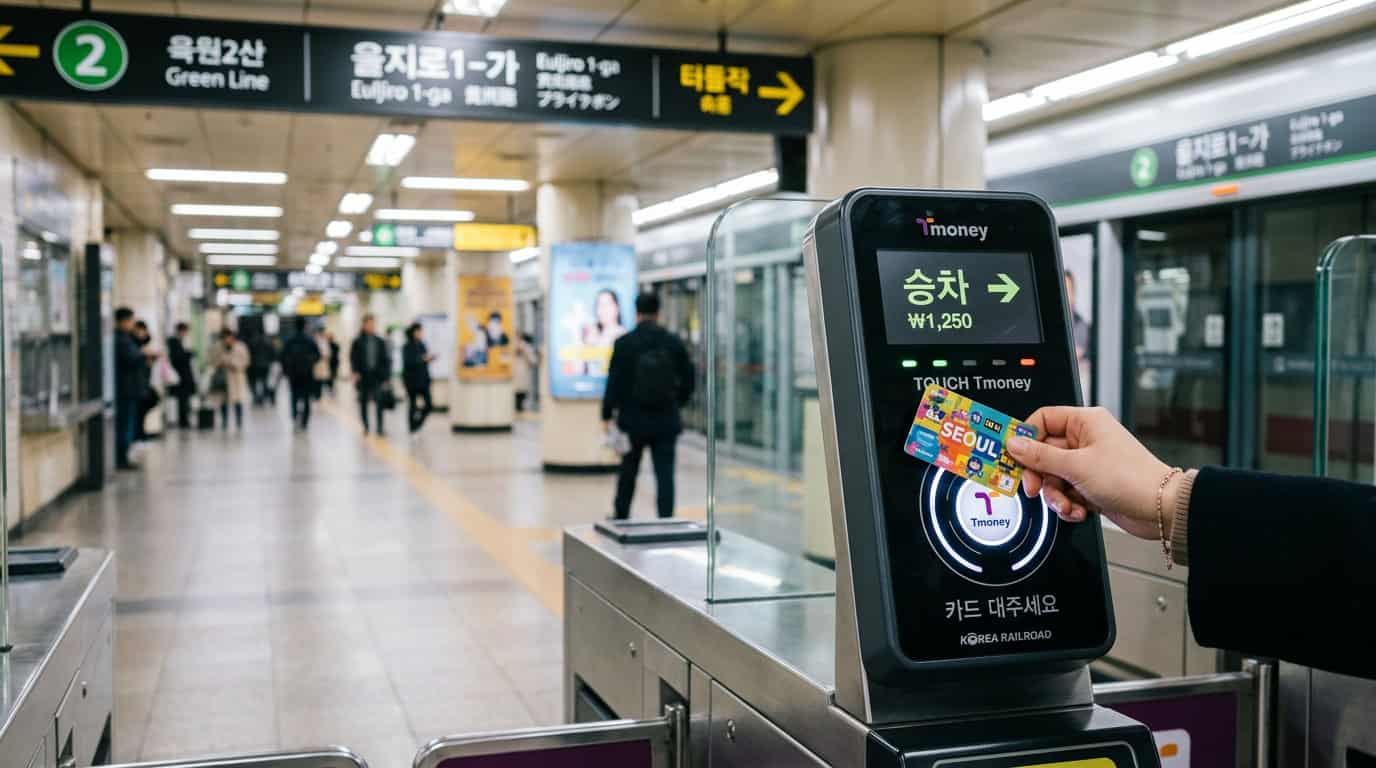
Public transit is the backbone of the Korean travel experience, and it is here that the ‘cashless’ paradox hits hardest. You cannot simply tap your international credit card at the subway turnstile. You need a dedicated transit card, the most famous of which is the T-money card.
How T-money Works
Think of the T-money card as a digital wallet specifically for your movement. You purchase the physical card—usually featuring a cute design—at any convenience store (GS25, CU, 7-Eleven) for a few thousand won. The card starts with a zero balance. You must load it with physical cash at a kiosk in any subway station or at the convenience store counter.
Pro-Tip for Smart Savings
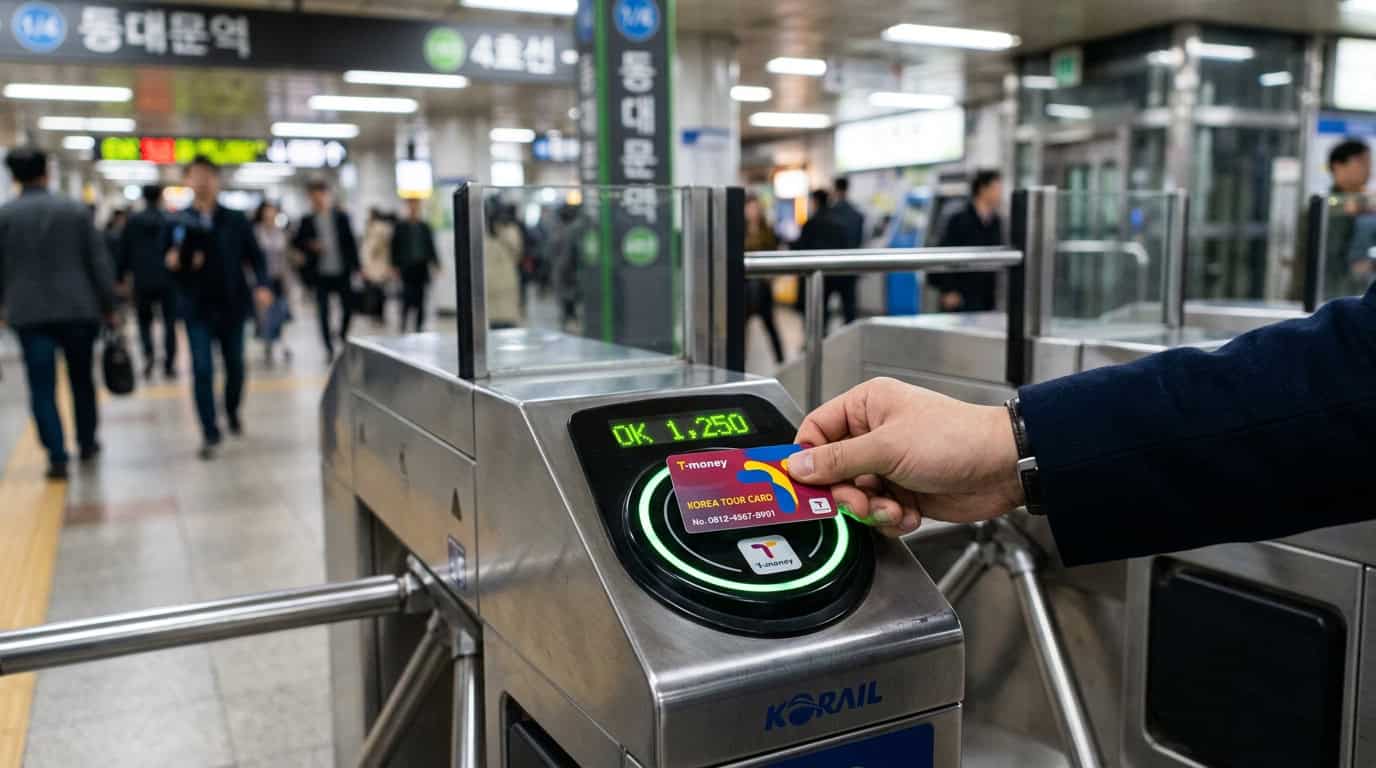
When I figured out the transfer policy, my travel costs dropped significantly. You can transfer between buses and subways up to four times a day at a reduced rate, provided the transfer occurs within 30 minutes (or one hour at night). Always remember to ‘tap out’ when leaving a bus or a subway gate, otherwise, the system will penalize you with a higher flat fare the next time you use it. This is a common trap that many tourists fall into. It is a small detail, but one that adds up over a two-week trip.
The Rise of Prepaid Travel Cards: WowPass and Namane
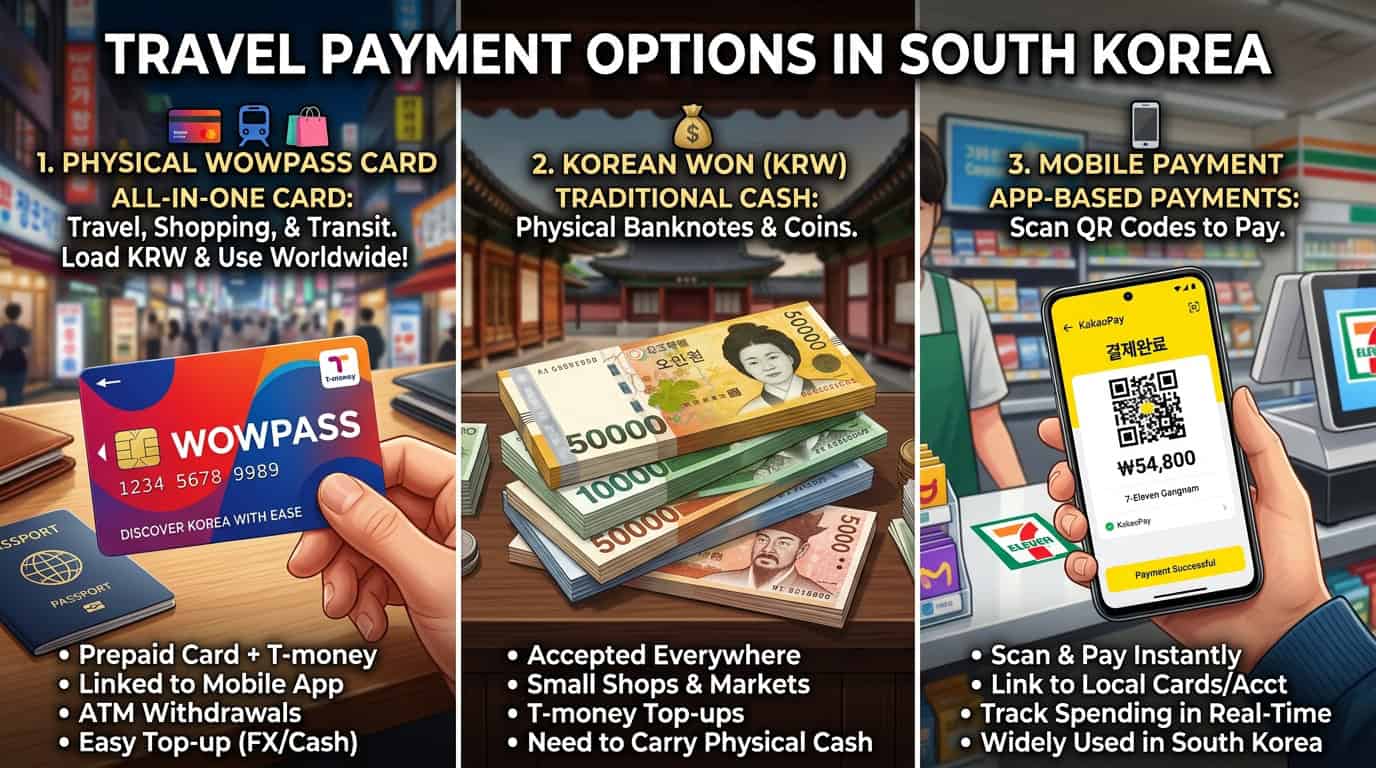
For the modern traveler, products like WowPass have become essential. These cards are essentially a hybrid: you deposit your home currency into a kiosk, and it issues you a card loaded with Korean won. Unlike a standard bank debit card, these are designed specifically for the tourist demographic.
I personally used a WowPass during a week-long trip to Seoul and found the instant currency exchange feature to be a lifesaver. It spared me from visiting a currency exchange booth, which often carries poor rates and long lines. The card can be used for payments in most major retailers and includes a T-money chip, so you can theoretically use the same piece of plastic for your subway fare and your dinner bill.
However, there is a limitation: the network is not 100% universal. If you are venturing into a very small, family-owned restaurant in a rural province, they might have an older terminal that prefers domestic-issued cards. This is why you should never rely on just one card. Carrying a backup physical card is always part of my travel ritual now, no matter where I go in Korea.
Understanding the Mobile Payment Landscape
If you live on your phone, you might be tempted to leave your wallet at the hotel. In Korea, this is a dangerous game. Samsung Pay is the absolute leader here, supported by almost every terminal because it uses both NFC and MST technology, allowing it to mimic a physical card swipe. If you have a Samsung device, you are essentially a local.
For everyone else, Apple Pay exists in Korea, but it is effectively ‘in beta’ for most tourists. It works at major chains like 7-Eleven, GS25, and some franchise cafes, but it is hit-or-miss at larger supermarkets like E-Mart or Lotte Mart. I once got to the front of a long checkout line at a large department store, only to have the Apple Pay transaction decline three times. The clerk looked at me with a tired expression, and I had to sheepishly pull out my physical credit card to finish the transaction. It was an embarrassing moment, but it taught me to never trust a phone-only strategy for payments in Korea.
Who Should Use Each Method?
To help you plan your budget and tech strategy, here is a breakdown of which payment method suits which type of traveler:
The Tech Enthusiast (Samsung User): You are golden. Add your domestic cards to your phone, but keep a T-money card for transit. You will rarely need physical cash.
The Short-Term Tourist (Apple/Other User): Prioritize getting a WowPass or Namane card on day one. Carry a credit card with no foreign transaction fees as your primary backup for hotels and upscale dining.
The Budget/Student Traveler: Focus on cash and T-money. If you plan to stay longer (like a semester of study), your priority is getting an ARC (Alien Registration Card), which will then allow you to open a local bank account and gain access to the full suite of domestic banking apps.
Cost Analysis: Is it Expensive?
Payment-related costs in Korea are generally low if you know how to avoid the ‘hidden’ fees.
Currency Exchange: Avoid exchanging cash at airport kiosks if you can; the spread is notoriously bad. Use your debit card at an ATM or use a service like WowPass, which transparently displays the rate at the kiosk before you commit.
Transaction Fees: Always check if your home bank charges for international transactions. If you are paying 3% per swipe, those charges add up quickly over a two-week trip. A card like a travel-specific debit (e.g., Wise or a similar neobank product) can save you upwards of $50–$100 in fees on a decent-sized trip.
-
-
- Transit Costs: Seoul is surprisingly cheap. A standard subway ride is usually less than $1.50 USD. Even with the Climate Card (the monthly unlimited pass), you are looking at roughly $45 USD for a month of travel. Compared to London or New York, the value is incredible.
-
Common Mistakes to Avoid
-
-
- Assuming ‘Card Accepted’ means ‘My Card Accepted’: You will see signs everywhere saying ‘Credit Cards Accepted.’ This refers to domestic cards. Always carry a secondary, different card (e.g., if you have Visa, carry a Mastercard) to maximize your chances of a successful terminal read.
- Relying on Mobile Wallets for Transit: Never expect to walk into a subway station and pay for the fare with your phone’s digital wallet. While some local apps are testing this, it is not standard for foreigners. You must have a physical T-money card to navigate public transit effectively.
-
Frequently Asked Questions
Do I really need to carry physical cash in South Korea?
Yes. While you can go days without touching paper money, you will eventually hit a wall. Street food vendors, local wet markets, and some rural bus routes simply do not have the infrastructure for card processing. Keeping around 50,000 to 100,000 KRW in your wallet as a ‘safety fund’ is a smart, standard practice for any experienced traveler in the country.
Can I use my international debit card at Korean ATMs?
Yes, but look for the ‘Global’ or ‘International’ sign on the ATM. Not every machine will accept foreign cards. Convenience store ATMs (like those inside GS25 or 7-Eleven) are usually the most reliable for foreign tourists. Be aware that these machines often charge a withdrawal fee of several thousand won per transaction, so it is better to withdraw larger amounts less frequently rather than small amounts daily.
What happens if my card gets declined at a restaurant?
It is usually not a reflection on your account balance, but a compatibility issue with the merchant’s terminal. Always have a backup. If you are in a group, ensure at least one other person has a card from a different bank or network. If you are alone, keep that 50,000 KRW emergency cash reserve handy so you aren’t left in an embarrassing situation after a meal.
Is the Climate Card worth it for a one-week trip?
Usually, no. The Climate Card (the unlimited pass) is designed for residents or those planning to use the subway 3–4 times every single day. For a casual tourist who might walk more or take fewer trips, a standard T-money card with pay-as-you-go top-ups is significantly cheaper and less stressful to manage.
Conclusion: Your Strategy for Success
My time in South Korea taught me that the best approach to money management there is one of ‘layered redundancy.’ Do not rely on one single method. Start your trip by securing a T-money card for all your transportation needs. Have a primary credit card with no international fees for the ‘big ticket’ items like hotels and upscale shopping. Keep a WowPass or a similar prepaid travel card for the daily ‘mid-sized’ purchases like lunch and coffee. Finally, always keep a small stack of physical won for the inevitable moment when a small vendor looks at your shiny plastic card and shakes their head.
If you prepare by diversifying how you pay, you remove the stress from your trip, allowing you to focus on the food, the sights, and the culture rather than the checkout line. Safe travels, and keep your T-money card topped up! Understanding the nuances of the Korean financial landscape turns a potential frustration into a seamless part of your daily routine, letting you navigate the country with the confidence of a seasoned local.